Good news
FDA Approves Wilserdly, Cutting Progression Risk 62% in ESR1-Mutated Breast Cancer
The FDA approved Genentech’s oral drug giredestrant, sold as Wilserdly, with everolimus for ESR1-mutated advanced breast cancer. In a 373-patient trial, ESR1-mutated patients went a median 10 months without progression, against 5.5 months.
This story runs on the good side only. The biggest stories of the day are told on both sides.

Women and men whose advanced breast cancer has outgrown standard hormone therapy have a new all-oral option. On 16 November the US Food and Drug Administration approved giredestrant, sold as Wilserdly, taken together with everolimus. The FDA notice says it is for adults with ER-positive, HER2-negative breast cancer that carries an ESR1 mutation and has returned or progressed on at least one hormone-based treatment. The agency approved it four weeks ahead of its goal date.
What the trial showed
The approval rests on evERA, a randomised, open-label phase 3 trial in 373 adults with locally advanced or metastatic ER-positive, HER2-negative breast cancer. Of them, 207 had ESR1 mutations. Patients received everolimus plus either giredestrant (183 patients) or their doctor’s choice of hormone therapy: exemestane, fulvestrant or tamoxifen (190 patients). Those comparison drugs are established treatments, so the benefit is measured against options patients can already get, not against no treatment at all.
Among patients with ESR1 mutations, the risk of disease progression or death was 62% lower with giredestrant, a hazard ratio of 0.38 (95% confidence interval 0.27 to 0.54), the FDA says. Median progression-free survival was 10 months against 5.5 months. Tumours shrank in 27% of patients on giredestrant and 14% on the comparison regimen. Overall survival data were immature when progression was analysed, so the trial does not yet show whether people live longer.
The trial population matters for who can use the drug. Genentech says the patients had progressed after a CDK4/6 inhibitor and hormone therapy. In both arms, patients who had not reached menopause received a drug to suppress ovarian function, and male patients received one too unless they had both testicles removed, the FDA says. That means the result applies to a broad group of adults, not only postmenopausal women, although the sources do not say how many men or premenopausal women were enrolled.
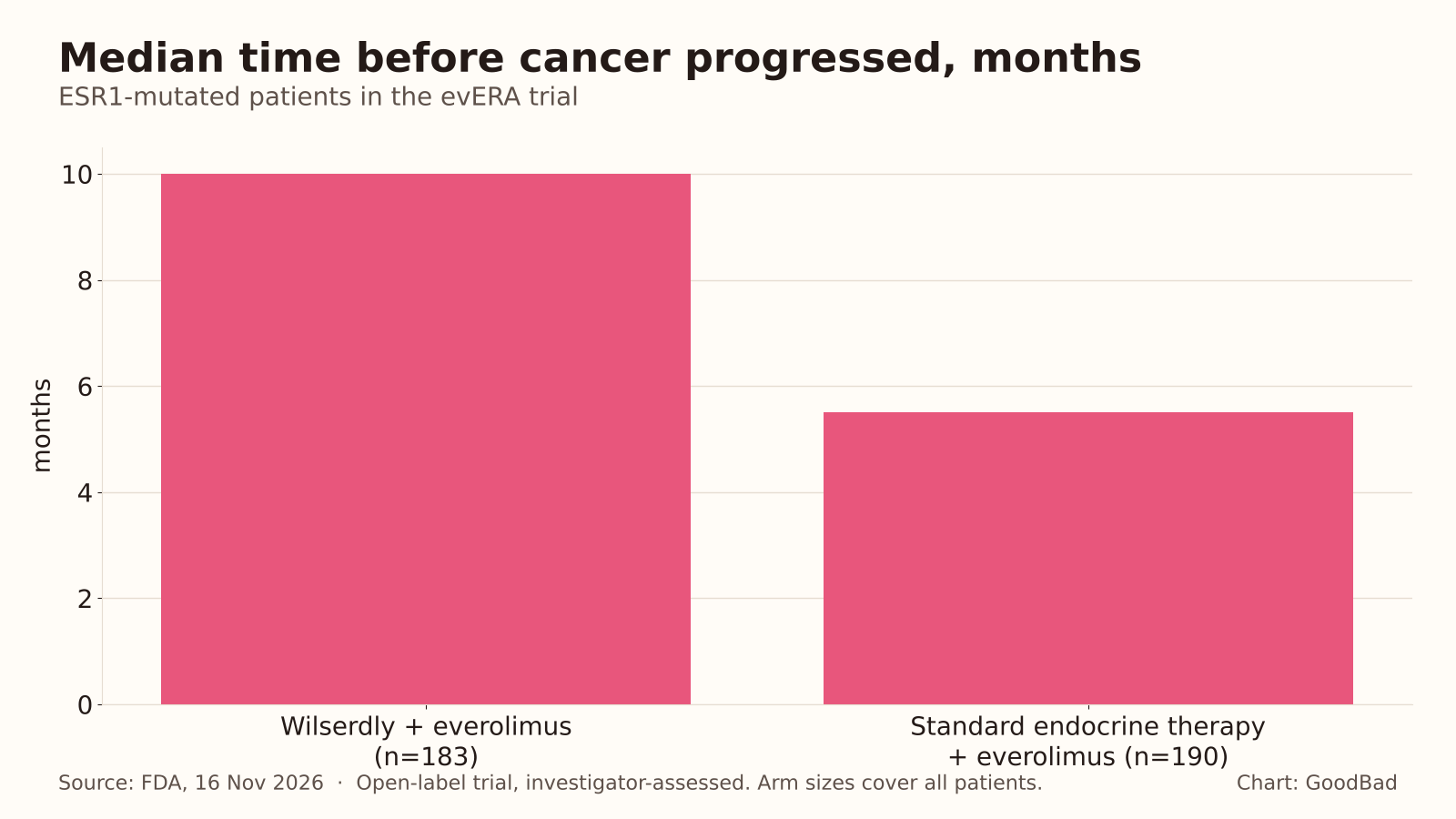 Chart: GoodBad. Data from the FDA approval notice, 16 November 2026. Open-label trial, progression judged by investigators.
Why ESR1 matters
ESR1 mutations are a common route by which hormone-driven cancers stop responding to treatment. Genentech, a member of the Roche Group, says they affect up to 40% of patients with hormone receptor-positive metastatic breast cancer. That is the company’s figure. Giredestrant is a drug that blocks the oestrogen receptor and triggers its breakdown, and the company says combining it with everolimus attacks two signalling pathways at once.
A blood test decides who qualifies. The FDA authorised the FoundationOne Liquid CDx assay, which reads tumour DNA circulating in the blood, as a companion diagnostic. Patients need a positive result for a specific set of ESR1 mutations, so doctors will need to order the test before prescribing.
The practical details
The recommended dose is 30 mg by mouth once daily, with or without food, until the disease progresses or side effects become unacceptable. Genentech stresses that the regimen is all-oral, with no injections, and says patients can take it at home. The company expects Wilserdly to be available in the United States within weeks.
On cost, Genentech says eligible patients with commercial insurance may pay as little as $0 through a co-pay assistance programme. A bridge programme may supply free drug while insurance is sorted out. The sources we read do not give a list price, and those programmes do not cover everyone, so the full cost to health systems remains unreported.
Side effects and limits
The most common adverse reactions, in at least one in five patients, were mouth sores, rash, fatigue, diarrhoea, musculoskeletal pain, lung inflammation and nausea, according to the FDA. Many patients also had lower blood counts on laboratory tests. The label carries warnings for slow heart rate and for harm to a fetus. Doctors and patients will weigh those effects against a gain of 4.5 months in the median time before the cancer progressed. The trial has not yet shown whether the gain translates into longer survival.
There are two caveats on the evidence. The trial was open-label, so patients and doctors knew which treatment was given, and progression was judged by investigators, not a blinded panel. The comparison group also received everolimus, which means the trial tests giredestrant against other hormone drugs and not against alternatives outside that pairing. Genentech calls the regimen the first all-oral next-generation combination of its kind to beat standard hormone therapy in this setting, a claim that is the company’s own.
What comes next
The FDA reviewed the application with Health Canada and Israel’s Ministry of Health under Project Orbis, which allows regulators to assess cancer drugs in parallel. The agency says the applications may still be under review elsewhere. Genentech reports that further filings outside the United States are under way.
The next date is 30 November, when the FDA is due to decide on giredestrant as an adjuvant treatment for earlier-stage breast cancer, based on a separate trial called lidERA. If approved, Genentech says, it would be the first new adjuvant hormone therapy in more than 20 years. For patients with ESR1-mutated advanced disease, the decision that mattered most has already been made, and the test that opens the door is available now.