Good news
FDA Approves Nelkarmi as Daily Pill Shrinks Lung Tumours in 49% of Patients
The FDA gave accelerated approval to neladalkib (Nelkarmi) for adults with ALK-positive lung cancer whose disease progressed on earlier drugs. Tumours responded in 49% of 67 patients after alectinib and 32% of 155 heavily pretreated patients.
This story runs on the good side only. The biggest stories of the day are told on both sides.
People whose lung cancer has outlasted their earlier treatments have a new pill to try. On 17 November the US Food and Drug Administration granted accelerated approval to neladalkib, sold as Nelkarmi by Nuvalent. It is for adults with locally advanced or metastatic non-small cell lung cancer driven by an altered ALK gene. The approval rests on a phase 1/2 trial with no comparison group, so the evidence is about tumour shrinkage, not yet about how long patients live.
Who it is for
Nelkarmi is a kinase inhibitor, a type of drug that blocks an overactive enzyme. The approval covers two groups of patients. The first has had one earlier ALK drug, and that drug must have been alectinib. The second has had two or more earlier ALK drugs plus platinum-based chemotherapy.
The second group has already been through targeted drugs and chemotherapy. A new option for them matters most, because few choices remain once those have been tried.
What the trial found
The FDA’s evidence comes from ALKOVE-1, a multicentre, open-label study in which every patient received the drug. Independent reviewers, blinded to the investigators’ views, measured tumours using the standard RECIST scale. The major measures were the share of patients whose tumours shrank by a confirmed amount, called the overall response rate, and how long each response lasted.
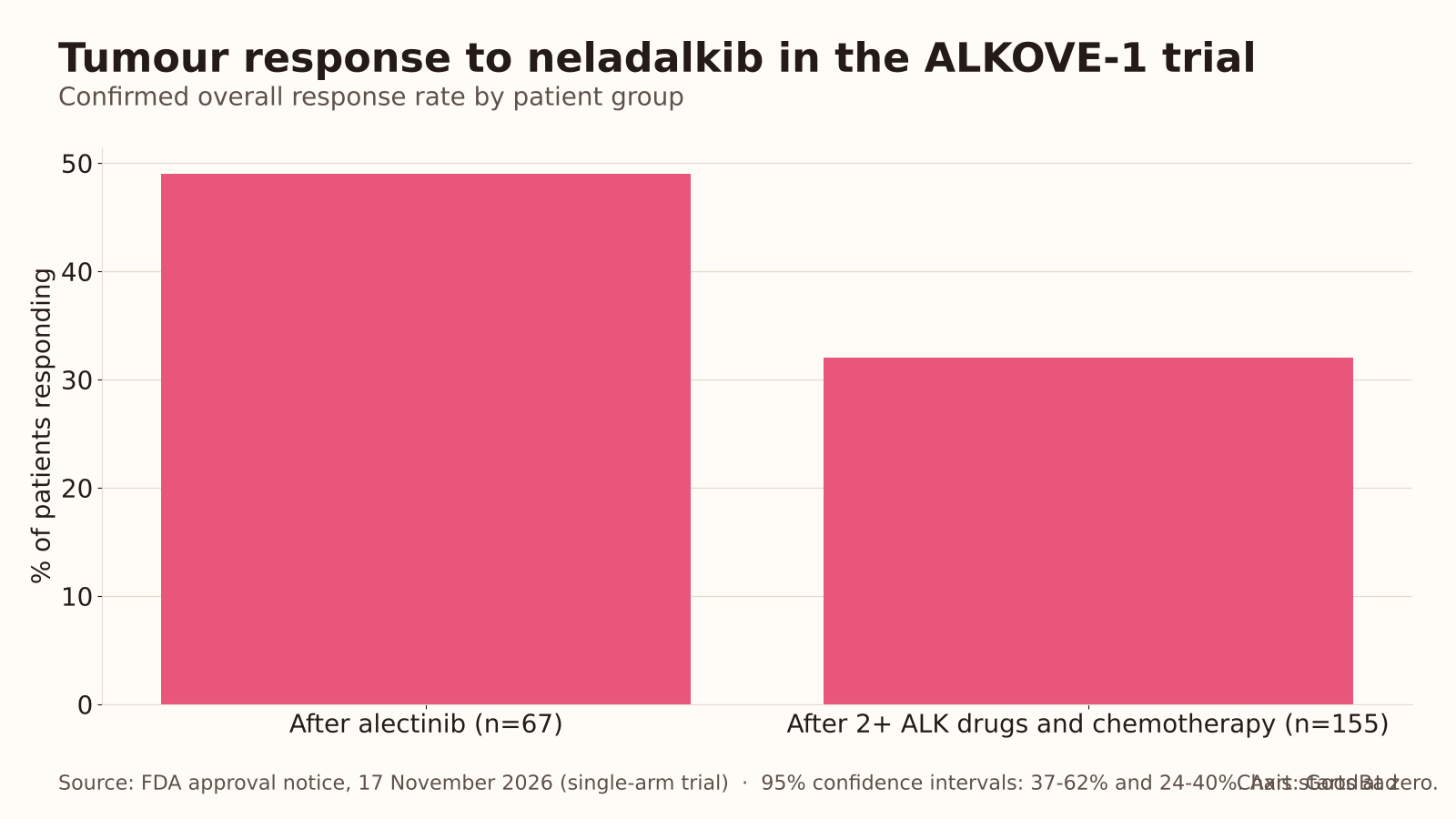 Chart: GoodBad. Data from the FDA approval notice of 17 November 2026.
| Group | Patients | Response rate | 95% confidence interval | Responses lasting 6+ months | Responses lasting 12+ months |
|---|---|---|---|---|---|
| After alectinib | 67 | 49% | 37% to 62% | 76% | 52% |
| After 2+ ALK drugs and chemotherapy | 155 | 32% | 24% to 40% | 69% | 51% |
Among patients who responded, about half were still responding at 12 months in both groups, according to the FDA. The confidence interval shows the range in which the true rate probably sits, and it is wider in the smaller group.
How to read the numbers
A response rate of 49% means that almost half of the 67 patients after alectinib had a confirmed shrinkage of their tumours. It does not mean that half were cured, and it does not mean the drug beats other options. Because every patient received Nelkarmi, the trial cannot say what would have happened on another treatment.
The second group is the harder test. Patients there had already tried at least two ALK drugs and chemotherapy, and a third of them still responded. That is a lower rate than in the first group, which is what a heavily pretreated population usually shows. The durability figures are the more encouraging part: about seven in ten responding patients in that group kept their response for six months or more.
What accelerated approval means
Accelerated approval lets a drug reach patients on a measure such as tumour shrinkage, before there is proof that it extends life. The FDA gave this application priority review, and the drug carries breakthrough therapy and orphan drug designations. Those labels apply to serious conditions with few existing treatments.
The trial registry entry shows the study is still recruiting. It lists an estimated 840 participants and an estimated primary completion date of December 2027, and it names Nuvalent as the sponsor. A company-sponsored trial is a point to keep in mind when reading its results, although the FDA’s figures come from blinded independent review.
The review also used what the FDA calls an Assessment Aid, a voluntary submission from the applicant meant to help the agency assess the application more quickly. That is a tool the company chose to supply, and the FDA says it did so in its notice. It speeds the paperwork. It does not change the evidence standard, which for accelerated approval is a measure that is reasonably likely to predict benefit, with proof still to come.
The side effects
The prescribing information carries warnings for liver toxicity, kidney toxicity, eye toxicity, raised creatine phosphokinase, a muscle enzyme, and harm to an unborn baby. The most common adverse reactions, in at least 20% of patients, were liver problems, muscle and joint pain, constipation, altered taste, nerve damage in the hands and feet, swelling and fatigue.
Anyone considering the drug should discuss those risks with their oncologist. The FDA lists the dose as 150 mg by mouth once a day, with or without food, taken at the same time each day until the disease progresses or side effects become unacceptable.
What we do not know yet
No source reviewed here gives a price, a launch date or a comparison with other ALK drugs, and the trial did not test one. The FDA says the full prescribing information will be posted on its Drugs@FDA database. Until then, the label’s wording on liver monitoring and dose changes is the detail to read.
The practical answer for most readers is narrow but real. If you or a relative have ALK-positive lung cancer that has progressed on alectinib or on several earlier treatments, ask an oncologist whether this approval changes the options. For everyone else, the approval shows that a targeted drug can still produce responses in patients who have already had several.
What happens next
The sponsor now needs to deliver confirmatory evidence, and the registry points to late 2027 for the main study’s primary completion. Results on how long patients live and how long before the disease worsens would show whether tumour shrinkage turns into longer, better life. Those are the numbers to watch.