Good news
Nelkarmi Wins FDA Approval for ALK Lung Cancer After Earlier Drugs Stop Working
The FDA has granted accelerated approval to GSK’s Nelkarmi, a once-daily oral drug for ALK-positive lung cancer that has progressed on other ALK drugs. In a 222-patient trial, 49% of patients after alectinib saw tumours shrink.
This story runs on the good side only. The biggest stories of the day are told on both sides.
People with ALK-positive lung cancer have a new option when the drugs they have been taking stop working. On 17 November the US Food and Drug Administration granted accelerated approval to neladalkib, sold as Nelkarmi. It is for adults whose cancer has spread or cannot be removed and who have already tried either alectinib alone or at least two ALK drugs plus platinum chemotherapy. The FDA notice and GSK’s announcement both describe the decision, which came ahead of the agency’s target date of 27 November.
What the trial found
The approval rests on ALKOVE-1, a global phase 1/2 trial with no comparison group. Its main efficacy analysis covered 222 patients: 67 whose only earlier ALK drug was alectinib, and 155 who had received two or more ALK drugs and chemotherapy. A confirmed response means the tumours shrank by a set amount on scans read by an independent panel.
In the alectinib group, 49% of patients responded (33 of 67, with a 95% confidence interval of 37% to 62%). Of those who responded, 76% kept the response for at least six months and 52% for at least 12 months. In the heavily pretreated group, 32% responded (50 of 155, interval 24% to 40%), and 69% and 51% of responders held on for the same periods, according to the FDA.
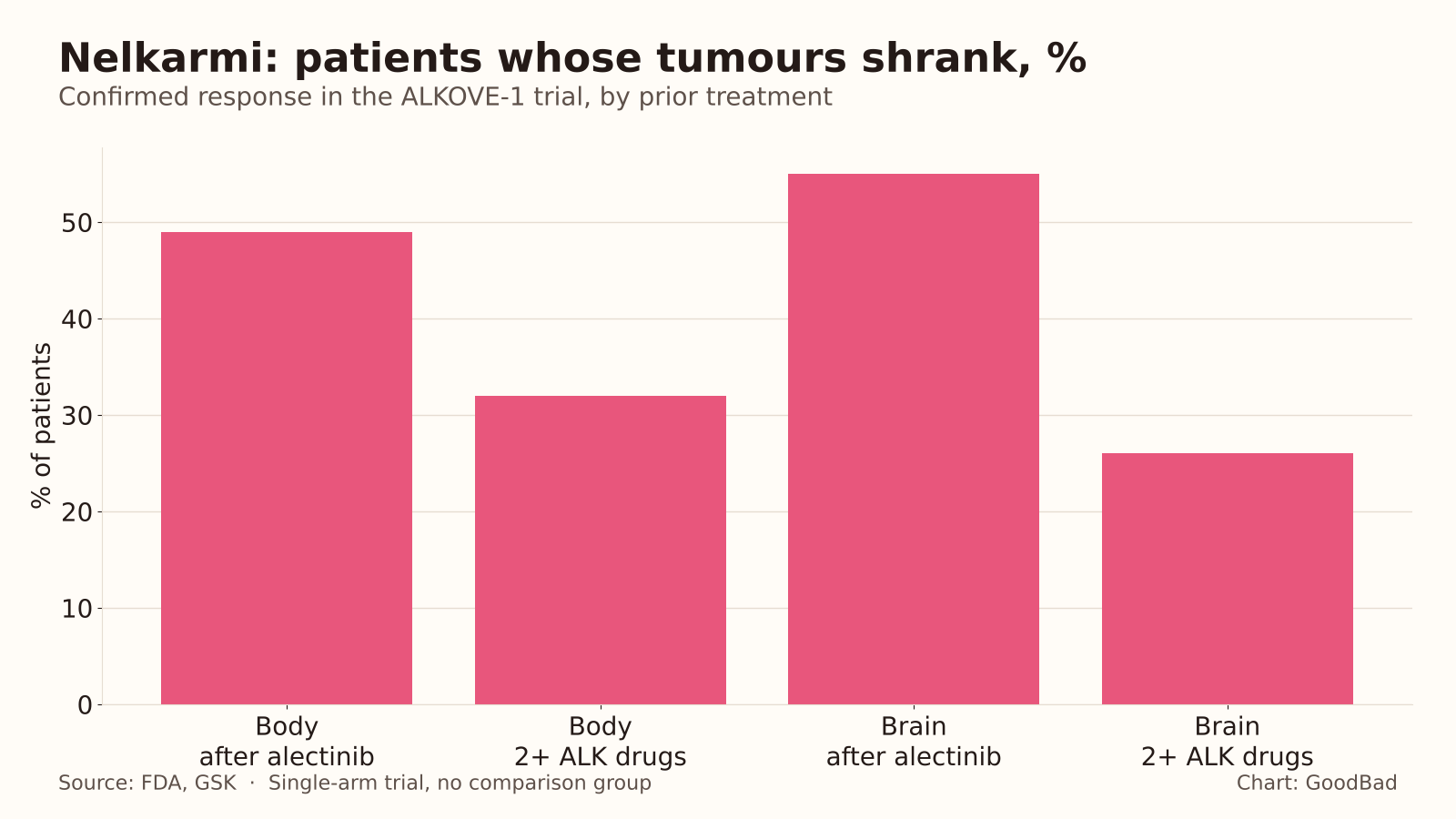 Chart: GoodBad. Data from the FDA notice and GSK’s release, 17 November 2026. Brain figures cover patients with measurable brain metastases (20 and 53 patients).
The brain question
ALK-positive cancers often spread to the brain, and that is where many drugs struggle to reach. GSK says Nelkarmi was designed to cross the blood-brain barrier. Some patients had measurable brain metastases at the start. Their brain tumours shrank in 55% of those who had taken only alectinib (11 of 20) and in 26% of the heavily pretreated group (14 of 53). Complete responses in the brain made up 25% and 11% of those groups.
Those groups are small. The 20-patient group in particular has a wide confidence interval, 32% to 77% according to GSK, so the figure is an early signal and not a settled rate. It is still a result in people whose disease had already outlasted other treatments.
Who can use it, and how
The drug is taken by mouth. The FDA says the recommended dose is 150 mg by mouth once a day, with or without food, until the cancer progresses or side effects become unacceptable. GSK’s chief scientific officer, Tony Wood, noted that ALK-positive patients are often younger and can stay on treatment for years, which makes tolerability as important as tumour shrinkage.
The most common side effects, affecting at least one in five patients, were liver problems, muscle and joint pain, constipation, altered taste, nerve damage in the hands and feet, swelling and fatigue. Permanent discontinuation because of side effects happened in 5% of patients, and liver toxicity was the most frequent reason, GSK says. The FDA label carries warnings on liver, kidney and eye toxicity, raised muscle enzyme levels and harm to a fetus.
Neither the FDA notice nor GSK’s release gives a price or says when the drug will reach pharmacies. Patients and doctors will need that from GSK before they can plan, and we do not report a figure here because none has been published in the sources we read.
What accelerated approval means
Accelerated approval is a pathway the FDA uses for serious conditions when early evidence, here tumour response and its duration, is judged likely to predict benefit. The sources we read report response rates and how long responses last, not survival, and the single-arm design cannot compare Nelkarmi with other drugs.
Two things are under way. GSK says the drug is being tested in ALKAZAR, a phase 3 trial in patients who have not yet had an ALK drug, and in other ALK-positive solid tumours. The ALKOVE-1 trial has enrolled 700 patients across its phase 1 and 2 parts. The FDA had granted the drug breakthrough therapy and orphan drug designations, and gave the application priority review.
How it fits GSK’s lung portfolio
Nelkarmi is GSK’s second lung cancer approval this year. The first, Jideytro (zidesamtinib), was cleared in July for previously treated ROS1-positive lung cancer, and both medicines came with GSK’s acquisition of Nuvalent, which the company describes as recent. The early decision brings the drug to US clinics ahead of the schedule the agency had set.
Alice Shaw, an ALKOVE-1 investigator at the Dana-Farber Cancer Institute, said in GSK’s release that the field is closer to managing ALK-positive lung cancer as a chronic condition. She added that balancing disease control with long-term tolerability remains a challenge. Kirk Smith, president of the patient group ALK Positive, said the approval is important progress for the community. Both are quoted by GSK, which is the company selling the drug, so their comments should be read as supportive voices and not as independent assessments.
The next test is the confirmatory evidence. For now, US patients who had run out of ALK options have a once-daily oral drug. Roughly one in three to one in two responded in the trial, depending on how many drugs came before it.