Bad news
Climate Finance Faces $840bn Gap as Saudi-Led Group Attacks UN Overshoot Report
An assessment cited at COP31 says climate finance could fall $840bn short of the $1.3 trillion goal, and Guterres says tripled adaptation money would meet under 30% of need. Saudi Arabia's bloc is questioning the UN overshoot report.

Read the good side of this story
Three Development Lenders Pledge $10bn for Emerging-Market Climate Projects at COP31

Climate finance for developing countries is heading for a shortfall of $840bn a year against its 2035 goal, according to an assessment highlighted at the COP31 summit in Antalya, Türkiye, UN News reports. The report does not name who produced the assessment. The goal is $1.3 trillion a year, of which developed countries are expected to lead on mobilising at least $300bn. On current trends, the gap is larger than what is being delivered.
On the same Friday, UN Secretary-General António Guterres said that even tripling adaptation finance for vulnerable countries would meet less than 30 per cent of what is needed. It was his last COP news conference before he leaves office at the end of the year. Countries are also still arguing about how to measure progress.
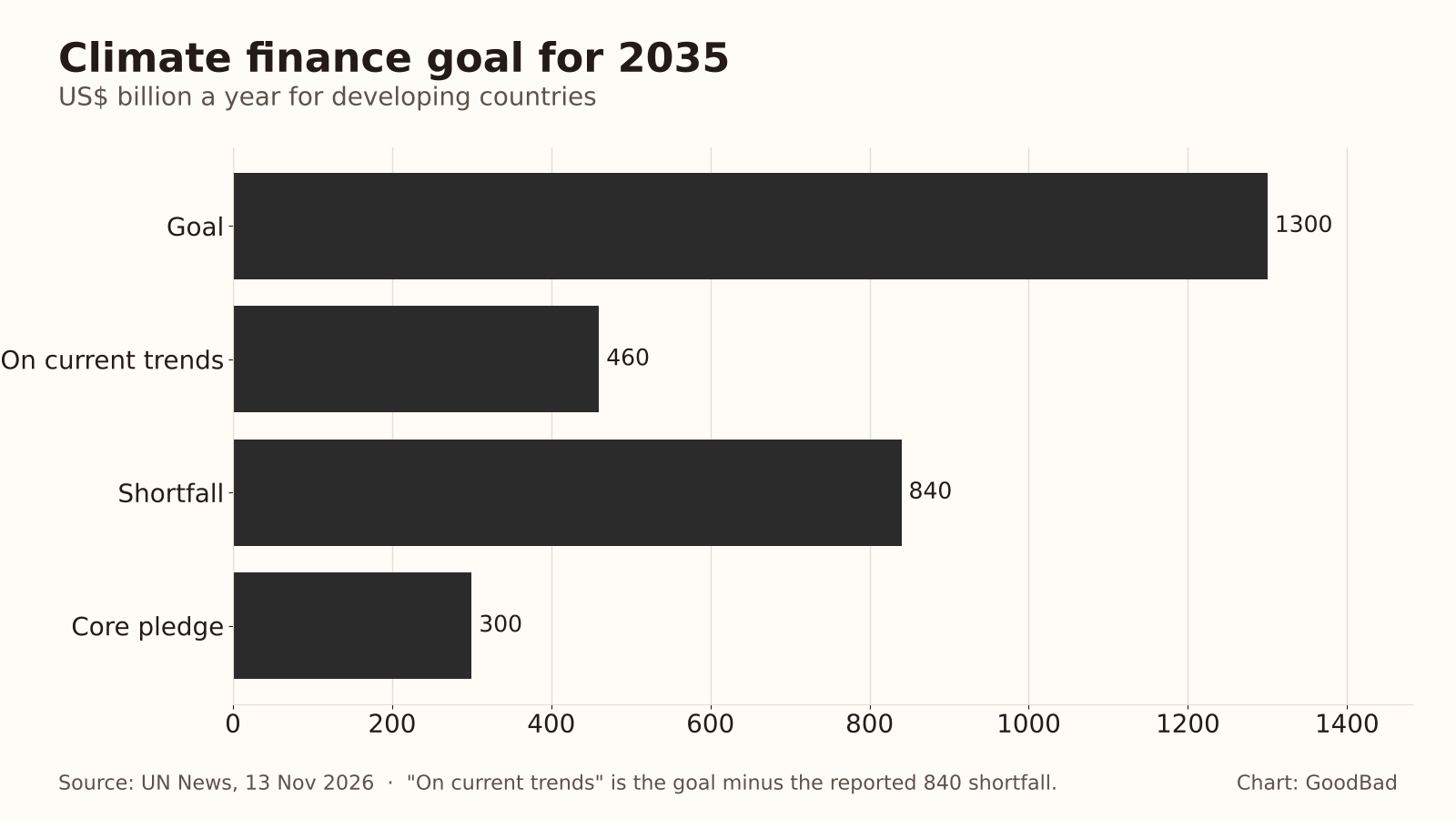 Chart: GoodBad. Data from UN News, 13 November 2026; the 460 figure is our subtraction of the reported shortfall from the goal.
The scale of the gap
The numbers come from UN News and are easy to compare. The goal is $1.3 trillion a year by 2035, and the shortfall is $840bn, which leaves about $460bn on the current path by our subtraction. The $300bn core pledge is the share that wealthy countries are expected to lead on. Development finance institutions from Britain, Norway and Canada have announced plans to mobilise $10bn by 2030. That is real money, though it runs to 2030 and is separate from the 2035 goal.
Africa’s priority in the draft text is to triple adaptation finance to at least $120bn a year by 2035, the Climate Home News bulletin reports. Another option would start a process to review the baseline, total and scope of the finance target adopted at COP30.
Countries disagree on which baseline to use when measuring tripling by 2035. Developing countries want stronger commitments from wealthy nations, while others favour private investment. Negotiators remain divided over predictable funding and help for vulnerable communities. The presidency has circulated a first outline of a political declaration, and finance and fossil fuels remain among the unresolved issues, according to UN News.
Who is not being reached
The farming sector shows where money fails to land. Kaveh Zahedi of the UN Food and Agriculture Organization said only around five per cent of climate-related development finance goes to agriculture, and that share is declining. Farmers face drought, floods and El Niño, and the FAO warns that not investing risks food insecurity and hunger.
Cost of capital is another barrier. A Nigerian activist asked why his country, which has contributed little to global emissions, faces far higher borrowing costs than wealthier nations. He spoke of Lake Chad, where drought and fluctuating water levels have devastated communities and displaced families. Guterres warned that climate disasters are erasing decades of development gains and called for reform of a financial system designed after the Second World War.
Insurance schemes exist but are small. One in the Pacific pays farmers when predefined conditions such as wind speed or rainfall are met. It operates across eight Pacific countries and has reached tens of thousands of people so far, UN News reports.
The fight over the science
The second dispute concerns the evidence for how far the world will overshoot 1.5C. Scientists behind the UN Environment Programme’s Limiting Overshoot report, published in September, defended it on Saturday after Saudi Arabia and other developing countries questioned its legitimacy, Climate Home News reports. During closed-door talks on the cover decision, the Arab Group led by Saudi Arabia argued the report had not been peer-reviewed, according to sources familiar with the discussions.
The Like-Minded Developing Countries bloc, which includes India and China, asked that the cover decision avoid references to reports produced outside the UN climate process. Observers read that as aimed at the UNEP report. The authors say 44 experts wrote it and 44 reviewers scrutinised it over a year, with governments the only group that did not review it.
Bill Hare of Climate Analytics, one of its reviewers, told Climate Home that fossil-fuel economies have least reason to accept an overshoot. Accepting it, he said, would mean taking on responsibility for paying for the damage. Laurence Tubiana of the European Climate Foundation said the attacks on the science target the institutions that give countries a shared basis for acting together.
The dispute sits inside a longer stand-off. Saudi Arabia, India and Russia have resisted an IPCC timeline that would deliver its key reports in time for the next global stocktake, due to be completed in November 2028. The IPCC will reconvene online in early December in a last-ditch effort to find a solution.
What happens next
A draft cover decision is expected early this week. UN climate chief Simon Stiell called progress so far “constructive” but urged governments to move quickly to the hardest issues and avoid tactical delays. The summit ends on Friday 20 November, with finance and the wording on overshoot still open. For recipient countries the practical question is whether the final text names a baseline and an adaptation number. One option in the draft would defer both to a later review.