Good news
Three Development Lenders Pledge $10bn for Emerging-Market Climate Projects at COP31
Development finance institutions from Britain, Norway and Canada plan to mobilise $10bn by 2030 as COP31 reaches its second week. Talks began on time, though an assessment says the wider finance goal is still $840bn short.

Read the bad side of this story
Climate Finance Faces $840bn Gap as Saudi-Led Group Attacks UN Overshoot Report

At the midpoint of the UN climate summit in Antalya, Türkiye, money moved. Development finance institutions from Britain, Norway and Canada announced plans on Friday to mobilise $10bn for climate projects in emerging markets by 2030, UN News reports. It is a small sum against the size of the task. It is also a concrete number, from named lenders, on a day when most of the summit’s headlines were about the gap.
That gap is real. An assessment highlighted at COP31, which UN News does not name, says annual climate finance could fall $840bn short of a $1.3 trillion goal on current trends. That leaves about $460bn on the present path, by our subtraction. Guterres adds that even tripled adaptation money would meet under 30 per cent of need. The rest of this piece is about what is being built against it.
Where the talks stand
COP31 runs through week two with a first outline of a political declaration already on the table. The presidency circulated it on Friday, according to UN News, and finance and fossil fuels remain the unresolved issues. A second text released overnight into Saturday is the main battleground for Africa’s top priority, the Climate Home News bulletin says: tripling adaptation finance to at least $120bn a year by 2035.
UN climate chief Simon Stiell told a Saturday press conference that progress so far has been “constructive”, the same bulletin reports. He praised countries for starting the negotiations on time, avoiding the fight over the agenda that had looked likely. A midway plenary on Saturday night, presided over by Türkiye and Australia, was due to show where each side draws its red lines. Ministers are now arriving to take up the hardest issues.
Nothing is settled. Most agenda items still need work, and the negotiating text is a wishlist of every proposal tabled that must be turned into a draft early this week. But the process is moving, and the summit has a calendar with dates in it.
The money in context
Under existing agreements, developed countries are expected to lead efforts to mobilise at least $300bn a year for developing nations by 2035, as part of the broader $1.3 trillion goal. UN News describes both figures. The new $10bn from the three lenders is a separate initiative aimed at emerging markets, and it runs to 2030.
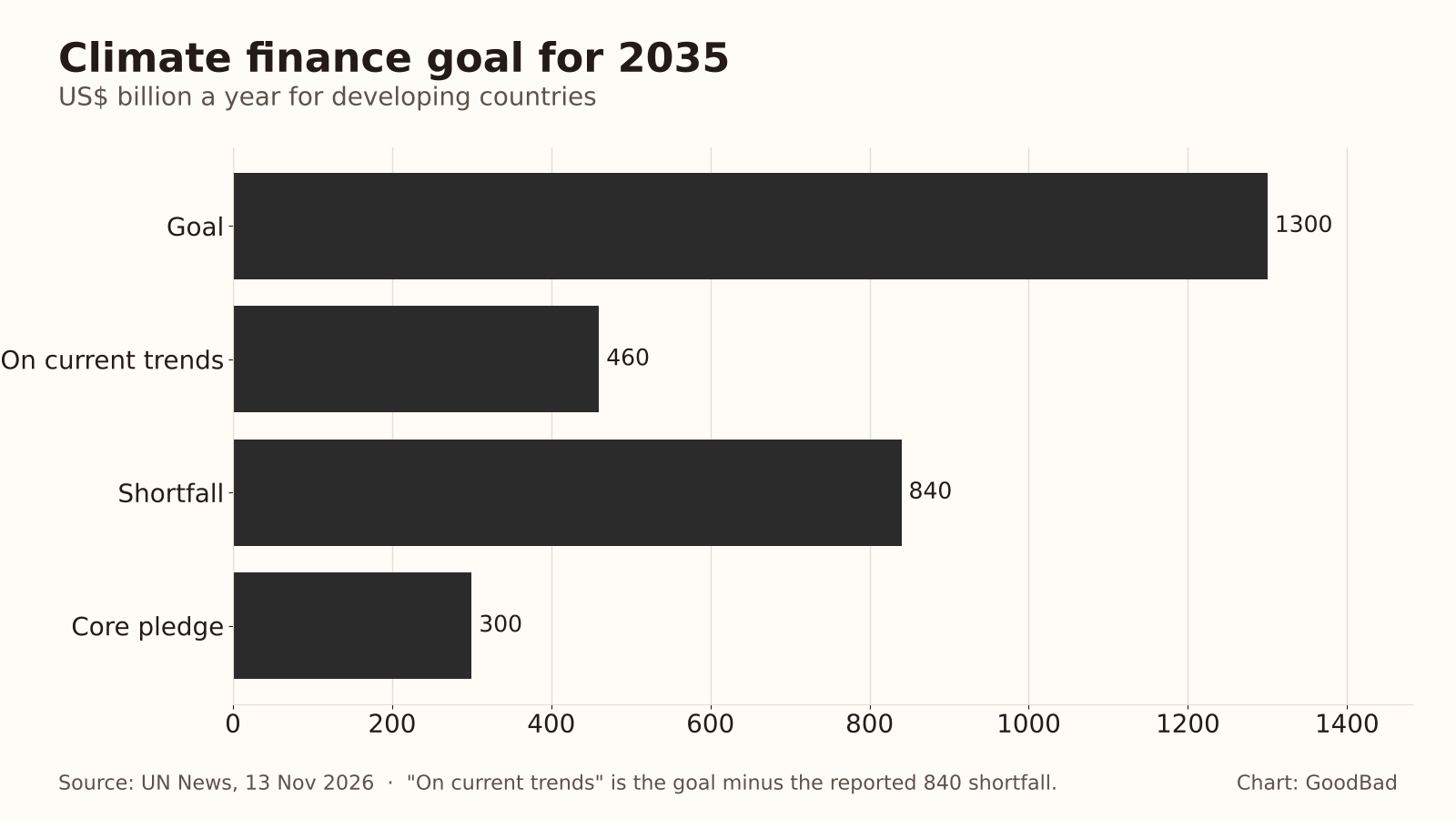 Chart: GoodBad. Data from UN News, 13 November 2026; the 460 figure is our subtraction of the reported shortfall from the goal.
António Guterres, at his last COP as UN Secretary-General, argued that reform of the international financial system could stretch every dollar. A dollar invested in the capital of a development bank can generate eight to ten dollars in financing, he said, and greater use of guarantees could attract private investment. He also met the heads of international climate funds on Friday and urged them to cut the bureaucracy that makes money hard to reach for countries with limited capacity. The multiplier is his estimate, not a measured result, and the new pledge is described only as an aim to mobilise funds.
Countries still disagree on how to measure progress towards tripling funding by 2035, including which baseline to use. Developing countries want stronger commitments from wealthy nations, while others prefer to mobilise private investment. One option in the draft text proposes a process to review the baseline, total and scope of the finance target adopted at COP30.
What the money can do
Money for farmers has been scarce: the UN Food and Agriculture Organization says only around five per cent of climate-related development finance goes to agriculture, and the share is declining. Kaveh Zahedi of the FAO argues that spending on adaptation can help farmers restore degraded land, use water more efficiently and grow crops that withstand droughts and floods.
One working model already exists in the Pacific. An insurance scheme pays farmers when predefined conditions, such as wind speed or rainfall, are reached. A farmer in Fiji whose fields are flattened by a cyclone does not wait for a damage assessment. The programme operates across eight Pacific countries, and tens of thousands of people have benefited so far, UN News reports. Sinja Buri of the United Nations University Institute for Environment and Human Security says speed matters, because the longer support takes, the longer recovery takes and the higher the costs.
The science question
The summit also has a fight over evidence. Scientists behind the UN Environment Programme’s Limiting Overshoot report, published in September, defended it on Saturday after Saudi Arabia and other countries questioned its legitimacy, Climate Home News reports. The Arab Group led by Saudi Arabia argued it had not been peer-reviewed, according to sources familiar with closed-door talks. The authors say it followed the standard process for a global assessment: 44 experts wrote it and a further 44 reviewers scrutinised it over a year.
The European Union, the UK, the least developed countries and small island states want the response to overshooting 1.5C to be a priority of COP31. The report asks how to limit an almost certain breach of the Paris Agreement temperature goal and bring temperatures back down. Its defenders have the weight of procedure behind them, because comparable reports are routinely used in IPCC assessment cycles.
What to watch
A draft cover decision is expected early this week, and the summit ends on Friday 20 November. The tests are concrete: whether the text carries the $120bn adaptation figure, whether overshoot is named, and whether the finance baseline is reviewed. The IPCC reconvenes online in early December to try to settle its own timeline dispute.