 Bad news
Melanoma Vaccine Shows No Survival Benefit Yet and No Price as Merck Seeks Approval
Merck and Moderna’s personalised vaccine cut recurrence risk 42% in 1,137 patients, but overall survival is unproven, 14.0% of vaccinated patients stopped a drug over side effects against 8.7%, and Merck has declined to say what it will cost.

Read the good side of this story
Personalised mRNA Vaccine Cuts Melanoma Recurrence Risk 42% in Large Phase 3 Trial
Merck and Moderna’s personalised melanoma vaccine has not yet been shown to help patients live longer, and nobody outside the companies knows what it will cost. In the phase 3 INTerpath-001 trial, 1,137 patients with surgically removed high-risk melanoma received pembrolizumab with either the vaccine or a placebo. The vaccine arm had a 42% lower risk of recurrence or death over two years, CancerNetwork reports, but the survival question is open. The data were presented at ESMO in Madrid on 24 October.
What is not yet shown
Overall survival is immature. Its hazard ratio was 0.77 with a 95% confidence interval of 0.45 to 1.31 (P = .33), which did not reach the trial’s prespecified significance boundary, according to a second CancerNetwork analysis. Follow-up for survival continues. The trial shows fewer recurrences at two years, not that more patients are alive.
The benefit also arrived late. In the first six months the recurrence hazard ratio was 0.99, meaning no difference, and it was 0.42 afterwards. Several smaller subgroups had confidence intervals crossing 1, including a US subgroup with a distant-metastasis hazard ratio of 1.77 based on only 10 events.
The side effects
Treatment-related side effects occurred in 95.8% of patients on the combination and 90.0% on pembrolizumab alone. Fever was 52.2% against 8.2%, and injection-site pain 51.0% against 9.5%. Investigators called the flu-like illness low grade and short-lived.
More patients stopped a study drug because of treatment-related effects: 14.0% on the combination against 8.7%. Serious (grade 3 to 5) treatment-related events were 14.2% against 13.4%. Two treatment-related deaths (0.3%) occurred in the combination arm, both attributed to pembrolizumab, not the vaccine.
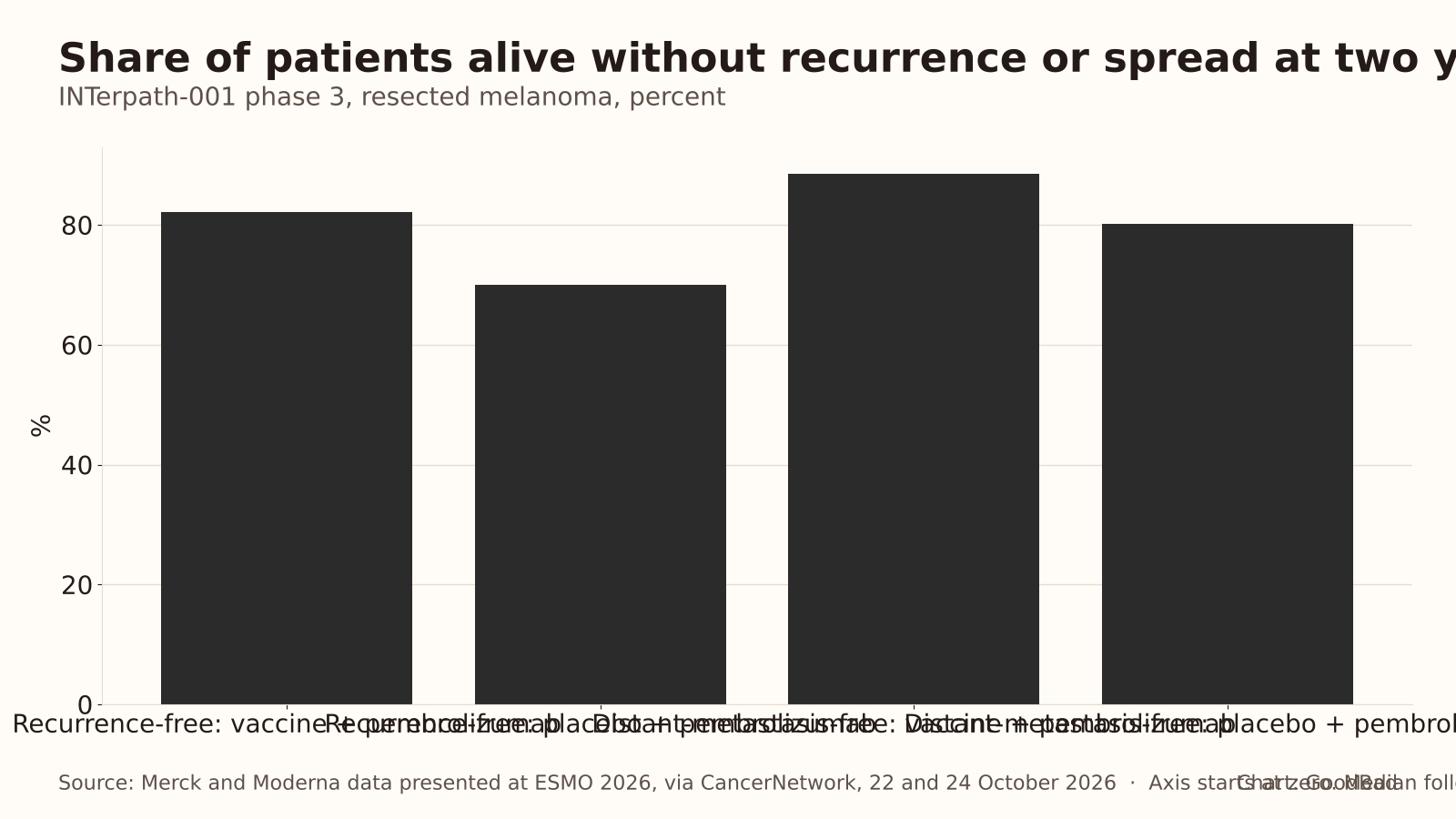 Chart: GoodBad. Data from Merck and Moderna’s INTerpath-001 results presented at ESMO 2026, via CancerNetwork, 22 and 24 October 2026.
Cost and access
The chart shows the gain that is real: 82.2% recurrence-free at two years against 70.0%. It also shows that 17.8% of vaccinated patients still had a recurrence or died within that time. Each dose is built from a patient’s own tumour sample, so NPR reports it will likely be expensive, and Merck declined to estimate a price. Merck plans to apply to the FDA, and approval could come next year.
Eliav Barr, Merck’s chief medical officer, called the result “just the beginning” and said similar vaccines are being tested in kidney and bladder cancer. Some data leaked on social media the day before the presentation, and NPR says investors who hoped for more dramatic results sold shares in both companies. Whether health systems will pay, and for whom, is the next test.