Good news
Personalised mRNA Vaccine Cuts Melanoma Recurrence Risk 42% in Large Phase 3 Trial
Added to the immunotherapy pembrolizumab, Merck and Moderna’s individualised vaccine lowered the risk of recurrence or death by 42% over two years in 1,137 patients after surgery. Approval filings are planned.

Read the bad side of this story
Melanoma Vaccine Shows No Survival Benefit Yet and No Price as Merck Seeks Approval
A cancer vaccine built from each patient’s own tumour has worked in a large, controlled trial. In the phase 3 INTerpath-001 study, adding Merck and Moderna’s intismeran autogene to the immunotherapy pembrolizumab cut the risk of melanoma recurrence or death by 42% compared with pembrolizumab and a placebo. The 1,137 patients had all had high-risk melanoma completely removed by surgery, and the results were presented at the ESMO congress in Madrid on 24 October, CancerNetwork reports. The data are accepted for publication in the New England Journal of Medicine.
What the trial found
At a median follow-up of 24.6 months, the hazard ratio for recurrence-free survival was 0.58 (95% confidence interval 0.45 to 0.75). Two years in, 82.2% of patients on the combination had no recurrence, against 70.0% on pembrolizumab alone. The chance of staying free of distant spread rose from 80.2% to 88.5%, a 38% lower risk.
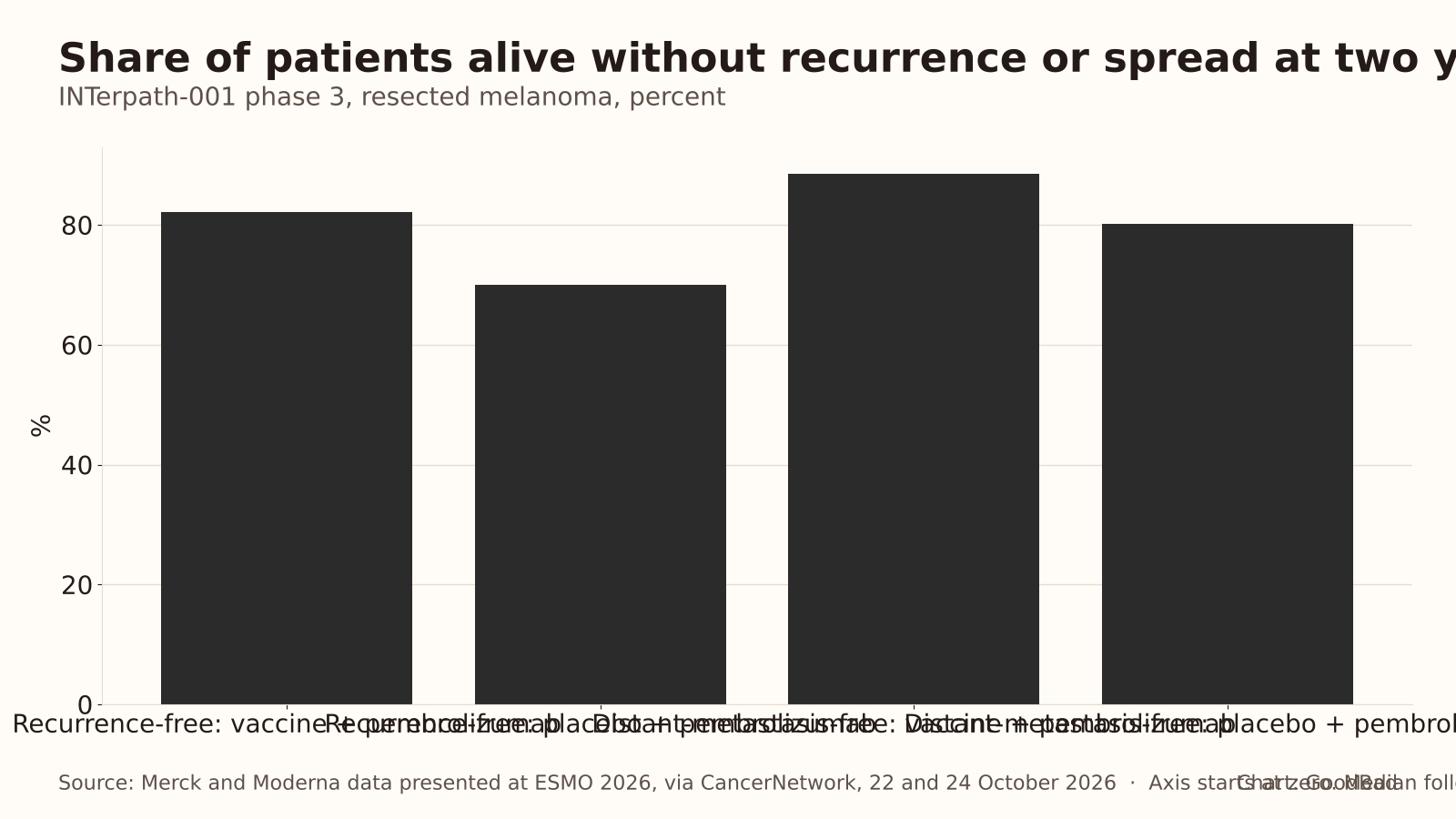 Chart: GoodBad. Data from Merck and Moderna’s INTerpath-001 results presented at ESMO 2026, via CancerNetwork, 22 and 24 October 2026.
The trial was randomised two to one and double-blind. Patients had stage IIB to IV cutaneous melanoma and had not had earlier systemic treatment. They received up to nine doses of the vaccine every three weeks, alongside up to nine cycles of pembrolizumab. The vaccine is designed from a sample of the patient’s tumour and encodes up to 34 neoantigens, the mutated proteins that mark cancer cells as foreign.
Who benefited
The effect showed up across the groups reported. In patients with stage IIB to IIIB disease the hazard ratio was 0.60, and for stage IIIC to IV it was 0.57, according to a second CancerNetwork analysis. Patients under 65 had a hazard ratio of 0.65 and those 65 and older 0.53. After the first six months, the recurrence hazard ratio was 0.42, and in the first six months there was no difference.
Side effects were mostly mild. Fever affected 52.2% of patients on the combination against 8.2% on pembrolizumab, and injection-site pain 51.0% against 9.5%. Investigators described the flu-like illness as low grade and short-lived. Serious (grade 3 to 5) treatment-related events were similar at 14.2% and 13.4%, and no new safety signals appeared.
Where it goes next
Merck says it plans to seek FDA approval, and NPR reports approval could come next year. Eliav Barr, Merck’s chief medical officer, called the result “just the beginning.” The company is testing similar vaccines in kidney and bladder cancer.
Two honest limits apply. Overall survival data are still immature, and the trial has not yet shown that patients live longer. Merck also declined to estimate a price. What the trial does show is that a personalised mRNA vaccine, a concept long promised, has produced a clear and statistically solid gain in a randomised test.