Good news
US Economy Grows 3.4% as Spending and AI Building Beat Forecasts
The US economy expanded at a 3.4% annual rate in the third quarter, up from 2.2% and above the 3.1% economists expected. Households kept spending and companies poured money into equipment, while jobless claims stayed low.

Read the bad side of this story
US Inflation Stays at 3.6% While Growth Leans on AI Spending

The US economy grew faster this summer than anyone forecast. The Bureau of Economic Analysis (BEA) estimated on 29 October that real gross domestic product rose at a 3.4% annual rate between July and September, up from 2.2% in the spring. Economists had expected 3.1%, CNBC reported. It is the first of three estimates for the quarter, so the figure will move.
Two engines, both running
Households did the steady work. Consumer spending rose at a 3.8% rate, the same pace as in the second quarter, and Yahoo Finance calls it the strongest stretch since late 2024. Real sales to private domestic buyers, a measure that strips out trade, government and stockpiles, grew 4.9%, against 4.6% in the second quarter.
Companies did the spectacular part. Gross private domestic investment jumped 19.4%, led by a 20.9% rise in spending on equipment and an 8.4% rise in intellectual property such as software and research. Charles Schwab’s Liz Ann Sonders called it another strong quarter for capital spending, and Navy Federal Credit Union’s Heather Long said business investment is turbocharging the economy. Much of that spending is the build-out of artificial intelligence.
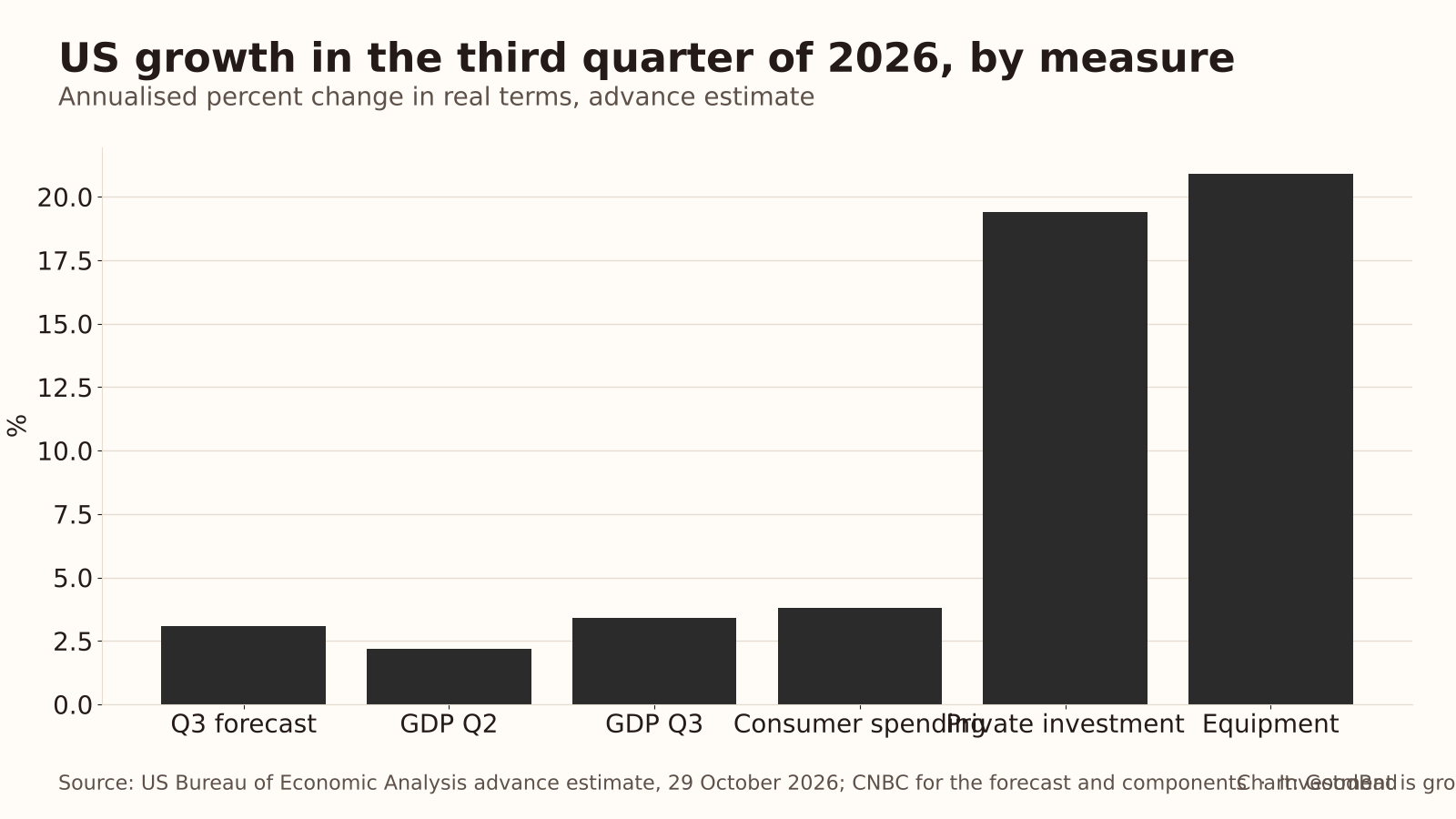 Chart: GoodBad. Data from the US Bureau of Economic Analysis advance estimate and CNBC, 29 October 2026.
An equipment boom works through a simple mechanism. Companies buy servers, chips and power gear now so that they can sell more later, and each purchase counts as output once it is delivered. That is why investment can swing a quarter by several points before any new product reaches a customer.
What it means for you
Work is still easy to find. Initial jobless claims were 194,000 in the week ended 24 October, below the 200,000 economists expected, according to CNBC. The Conference Board, which Yahoo Finance cites, says consumer confidence is improving.
Growth that comes from spending and investment, rather than from a one-off swing in trade or stockpiles, tends to carry into the next quarter, though no source here forecasts the fourth. The BEA publishes its second estimate on 25 November.
The release also lands at a political moment. Yahoo Finance notes it is the last major economic report before next week’s midterm elections, and that the White House promoted it. The mix inside the number matters more than the date. Spending, investment and real sales to private buyers all moved up together, and that is a sturdier base than a quarter lifted by a swing in stockpiles.
The price tag
The same morning brought September’s inflation reading, and it was not soft. The BEA’s preferred price gauge rose 0.5% in the month and 3.6% over the year, and core prices rose 3.1%. In September alone, spending rose 0.5% and personal income 0.2%, a touch under the 0.6% and 0.3% forecasts. Gasoline and other energy goods jumped 9.2% in September, which CNBC identifies as the main driver. Over the whole quarter, though, prices rose at a 2.1% annual rate, well below the 5% of the second quarter, and the core rate eased to 2.5% from 3.3%.
The Federal Reserve left its benchmark rate at 3.75% to 4% this week. Chair Kevin Warsh said the period ahead is “information rich,” and Fwdbonds economist Chris Rupkey said growth is powering ahead despite geopolitical risks. Trade was the one clear drag: exports fell and imports rose, and imports are subtracted from the total. Sonders noted that the AI build-out leans heavily on imports, so part of the investment boom is built abroad.