Good news
World Bank Expects Commodity Prices to Fall 7% in 2027 After This Year’s Surge
The World Bank’s October outlook has commodity prices easing 7% in 2027 after a 23% rise this year, with Brent oil back to $79 and fertilizer and European gas falling. Its forecast assumes no major escalation of conflicts.

Read the bad side of this story
Commodity Prices Jump 23% This Year as War Drives Energy Up 32%
The World Bank expects the price spike of 2026 to be a peak, not a new normal. Its Commodity Markets Outlook, published on 28 October, has commodity prices falling 7% in 2027 after rising 23% this year. The bank attributes this year’s jump to the Middle East conflict, disrupted grain shipments and weather, as Reuters reported. The forecast assumes that conflicts do not escalate significantly.
Where prices ease
Energy leads the rise this year, with prices up 32% after three years of declines. The bank expects Brent crude to average $91 a barrel in 2026, up from $69 in 2025, and to slip to $79 in 2027. A companion blog post puts the 2028 average at $70.
European natural gas, which has risen about 60% this year, is forecast to fall about 8% in 2027 and almost 30% in 2028. Fertilizer, which rose 14% in 2026, drops back to its 2025 level in 2027, a fall of about 12% on the blog’s figures. That matters for the food bill, because fertilizer is one of a farmer’s largest costs.
| Index | 2026 | 2027 |
|---|---|---|
| All commodities | +23% | -7% |
| Food | +10% | +7% |
| Fertilizer | +14% | -12% |
| Metals and minerals | +25% | -3% |
| Precious metals | +40% | -8% |
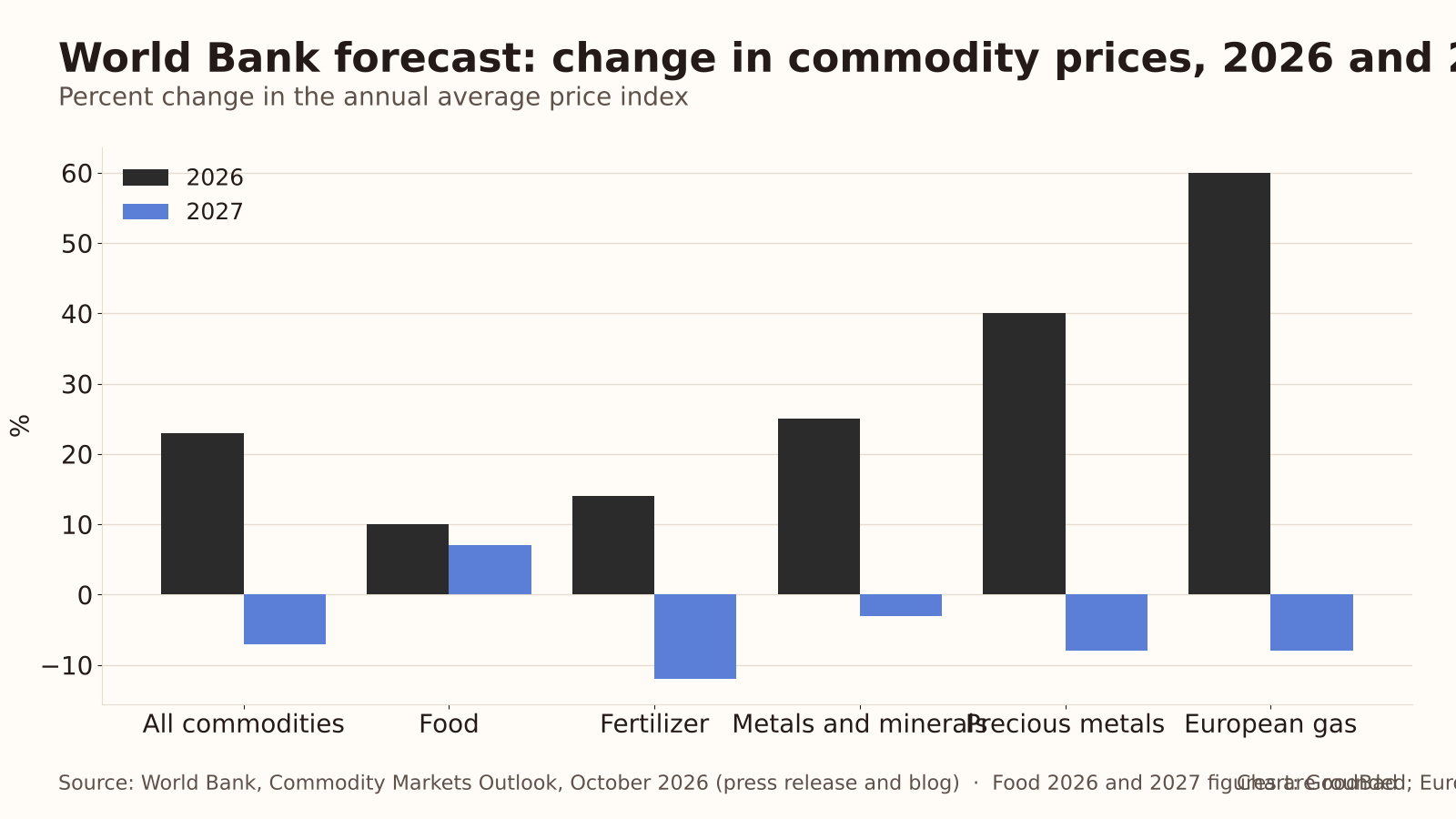 Chart: GoodBad. Data from the World Bank Commodity Markets Outlook, October 2026.
Why would prices fall? Part of the answer is demand. The bank says global oil consumption drops 2.5% in 2026. High prices and shortages force buyers to cut back, and weaker demand tends to pull prices down once supply stabilises. The conflict has also drawn down oil inventories, which the bank counts among the drivers of this year’s jump, so restocking is a risk as well as a recovery.
What it means for you
Food is the exception to the easing. The bank forecasts food commodity prices up about 10% this year and 7% next, a cumulative 18%, though that follows a 21% decline over 2022 to 2025. Beverages are cheaper: their prices fall about 24% in 2026 as the bank expects coffee and cocoa supply to recover.
For households, the forecast points to fuel and fertilizer-linked costs levelling off over the next year rather than climbing again. The bank does not publish retail prices, so how fast any easing reaches fuel pumps or shop shelves is not in its numbers.
Not every price comes down. Metals and minerals ease only 3% in 2027 and stay 16% above their 2021 peak, according to the blog. Precious metals fall about 8% but remain more than three times their 2015 to 2019 average. American natural gas is roughly flat this year and is forecast to rise about 6% in 2027, so the European relief is not mirrored across the Atlantic.
The conditions attached
The outlook is conditional. In the bank’s adverse scenario, a Middle East escalation, lasting damage to Russian oil facilities, attacks on Black Sea grain shipping and a very strong El Niño arrive together. Brent would then average $105 in 2027, and food prices would sit 12% above the baseline.
Ayhan Kose, the bank’s deputy chief economist, said commodity markets are being hit by several major shocks at once. The bank says $50 billion to $60 billion is available through its existing instruments, including $25 billion in pre-arranged financing, to help countries cope. The next outlook is due in April 2027.