Bad news
Commodity Prices Jump 23% This Year as War Drives Energy Up 32%
The World Bank says commodity prices will rise 23% in 2026, led by a 32% jump in energy and a 25% rise in metals, with food up a further 7% in 2027. Its worst case puts Brent at $105 and food prices 12% higher.

Read the good side of this story
World Bank Expects Commodity Prices to Fall 7% in 2027 After This Year’s Surge
Energy, metals and food are all getting dearer at once, and the people with the least room in their budgets pay first. The World Bank’s Commodity Markets Outlook, published on 28 October, forecasts that commodity prices rise 23% in 2026. The bank blames the Middle East conflict, disrupted grain shipments and weather, Reuters reported. Prices are forecast to fall 7% in 2027, on the condition that conflicts do not escalate significantly.
Energy takes the first hit
Energy prices rise 32% this year, reversing three years of declines. Brent crude is forecast to average $91 a barrel in 2026, against $69 in 2025. The bank’s companion blog post says Brent topped $110 in mid-October.
Supply is the problem. The bank says global oil supply falls 5.2% in 2026, the largest drop in more than four decades outside the 2020 recession. Consumption falls 2.5%, the third-largest annual contraction on record after 2020 and 1980, because prices and shortages force buyers to cut back. European natural gas is up about 60% on the year, and European and Asian liquefied natural gas prices had more than doubled from their pre-conflict levels by September, according to the blog.
The conflict has also drawn down oil inventories, which leaves less cushion if supply is hit again. The forecast assumes that conflicts do not escalate significantly. If they do, the energy numbers above could prove too low, and a second shock would land on markets with thinner buffers than before.
Food and fertilizer
Food commodity prices rise about 10% in 2026 and a further 7% in 2027, a cumulative 18%. The bank cites higher energy and fertilizer costs, attacks on Black Sea shipping and a strong El Niño. Fertilizer is up 14% this year. Metals and minerals rise 25% to a record annual average, with aluminium, copper and tin at record highs.
| Index | 2026 | 2027 |
|---|---|---|
| All commodities | +23% | -7% |
| Food | +10% | +7% |
| Fertilizer | +14% | -12% |
| Metals and minerals | +25% | -3% |
| Precious metals | +40% | -8% |
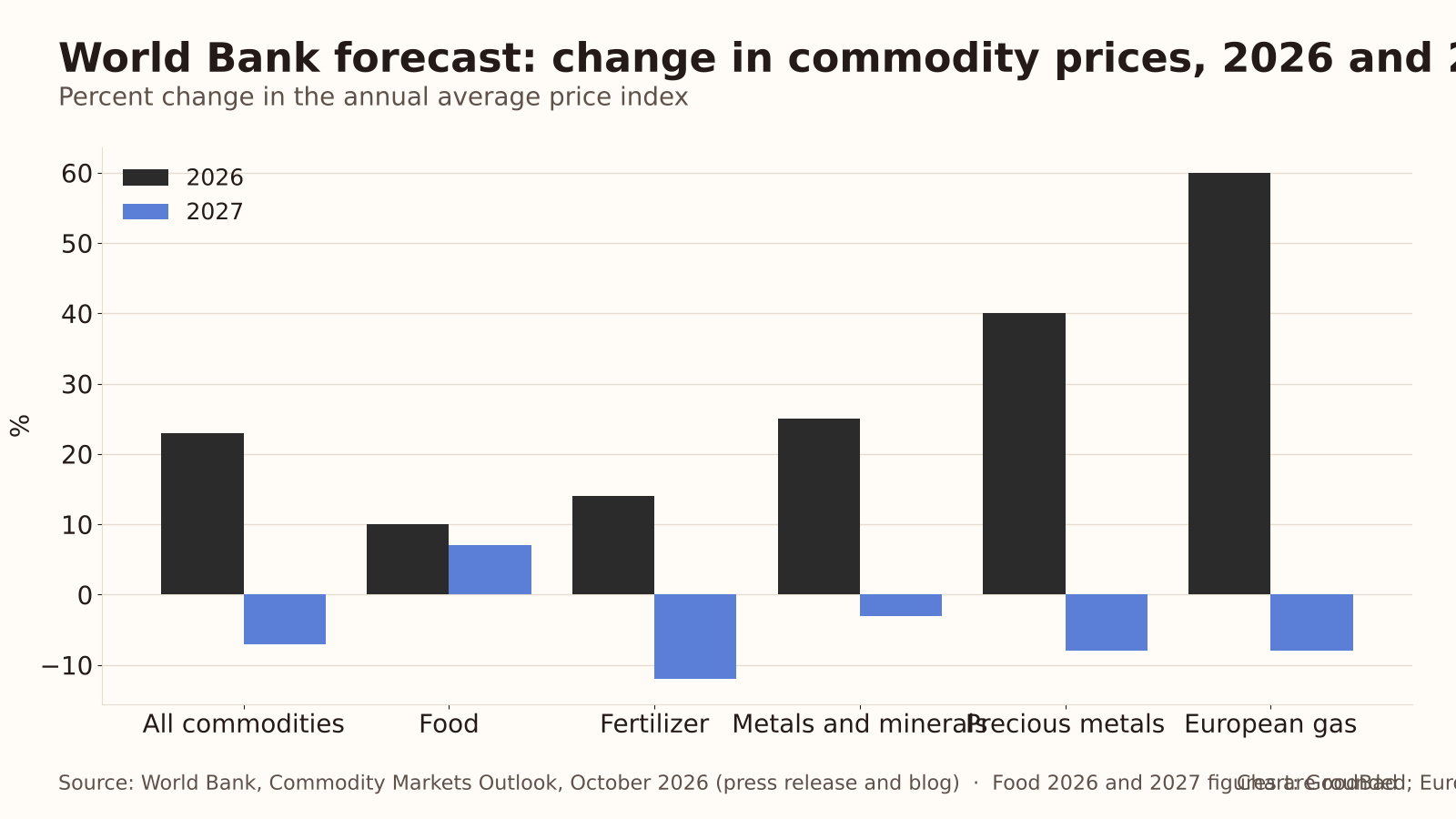 Chart: GoodBad. Data from the World Bank Commodity Markets Outlook, October 2026.
Not every market moves together, which helps and hurts. American natural gas is roughly flat this year, so European buyers carry far more of the energy shock than American ones. Even the forecast easing is slow. Metals fall only 3% in 2027 and stay 16% above their 2021 peak. Precious metals, up about 40% this year, remain more than three times their 2015 to 2019 average.
The worse case
The bank’s adverse scenario combines a Middle East escalation, lasting damage to Russian oil infrastructure, Black Sea grain attacks and a very strong El Niño. Brent would then average $105 in 2027, food commodity prices would sit 12% above the baseline and surpass 2022 levels, and grains would be 20% higher.
Ayhan Kose, the bank’s deputy chief economist, said commodity markets are being hit by several major shocks at once. The bank warns that export bans could fragment markets and push prices higher, as in 2007 to 2008. It recommends targeted social safety nets. It says $50 billion to $60 billion is available through its existing instruments, including $25 billion in pre-arranged financing. Beverages are the one clear relief: their prices are down about 24% this year as coffee and cocoa supply recovers. The next outlook is due in April 2027.