 Bad news
US Inflation Stays at 3.6% While Growth Leans on AI Spending
The US grew at a 3.4% annual rate in the third quarter, but the BEA’s preferred price gauge still rose 3.6% over the year. Investment did the heavy lifting, imports offset part of it, and income growth lagged spending.

Read the good side of this story
US Economy Grows 3.4% as Spending and AI Building Beat Forecasts

Prices are still rising at 3.6% a year, and the economy that is outrunning them leans hard on one source of demand. The Bureau of Economic Analysis (BEA) reported on 29 October that its preferred price index rose 0.5% in September and 3.6% over twelve months. Core prices, which exclude food and energy, rose 3.1%. CNBC says energy caused most of the monthly jump: gasoline and other energy goods rose 9.2% in a single month.
The growth underneath
The same agency estimated that real gross domestic product grew at a 3.4% annual rate in the third quarter, up from 2.2%, and ahead of the 3.1% economists expected. That is a good number. The question is what holds it up. Gross private domestic investment rose 19.4%, led by a 20.9% jump in equipment and an 8.4% rise in intellectual property. Consumer spending rose 3.8%.
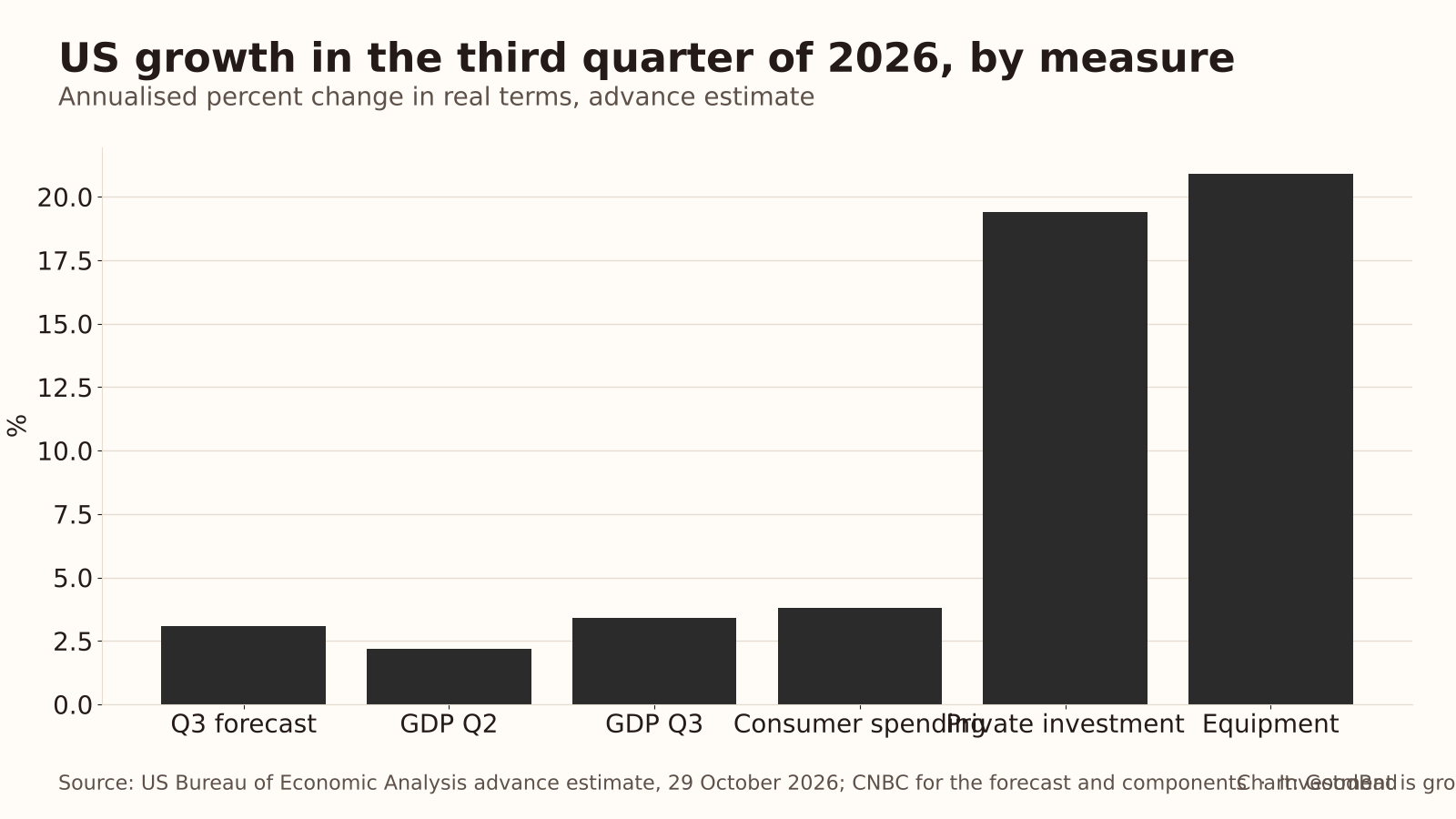 Chart: GoodBad. Data from the US Bureau of Economic Analysis advance estimate and CNBC, 29 October 2026.
Much of the investment is the build-out of artificial intelligence, and Yahoo Finance reports that Charles Schwab’s Liz Ann Sonders calls that build-out very import-driven. Trade was the one clear drag on the quarter: exports fell and imports rose, and imports are subtracted from GDP. Part of the boom, in other words, is paid to suppliers abroad.
Spending ahead of pay
Households kept spending at a 3.8% rate, the same as in the second quarter. Their pay did not keep pace in September. Personal income rose 0.2% against a forecast of 0.3%, while spending rose 0.5%, a shade under the 0.6% economists expected, according to CNBC. Prices rose faster than income in the month, so the gap between them has to be covered by savings or credit.
The quarter as a whole looks gentler on prices. Over the three months, the price index rose at a 2.1% annual rate and the core index at 2.5%, down from 5% and 3.3% in the spring. September undid some of that calm, and the annual rate of 3.6% is the one households have lived with for a year.
Yahoo Finance notes that this is the last major economic report before next week’s midterm elections, and that the White House promoted it. Voters will judge an economy in which a headline growth rate of 3.4% sits beside prices 3.6% higher than a year ago. Growth is the number the White House can point to. Prices are the number that shoppers see at the till and the gas pump every week.
What the Fed is looking at
The Federal Reserve held its benchmark rate at 3.75% to 4% this week. Chair Kevin Warsh said the period ahead is “information rich.” Fwdbonds economist Chris Rupkey said growth is powering ahead despite geopolitical risks. That cuts both ways, because strong demand makes it harder for prices to cool.
For the labour market the news was steady. Initial jobless claims were 194,000 in the week ended 24 October, below the 200,000 forecast. The 3.4% is an advance estimate, and the BEA will revise it on 25 November. If the AI spending slows before wages catch up with prices, the gap between the two numbers is what households will feel first.