Good news
Cash Rewards Double Quit Rates Among Smokers Referred for Lung Screening
In a JAMA trial of 3,220 smokers, offering up to $600 for confirmed quitting lifted six-month abstinence to 8.8 percent from 4.3 percent with usual care. Free medication alone made no significant difference.
This story runs on the good side only. The biggest stories of the day are told on both sides.
Paying people to quit smoking worked better than anything else tested in a large US trial, and the effect was clear in a group that rarely gets help. In a randomised trial published in JAMA, 8.8 percent of smokers who were offered up to $600 for confirmed quitting were still abstinent at six months. Among those given usual care the figure was 4.3 percent.
The trial, called Healthy Lungs, enrolled adults who smoke and had been referred for lung cancer screening at five centres in four US health systems. ASCO Post reports that 3,259 people were randomised and 3,220 were included in the main analysis. They were chosen because they are often left behind by health care: all were Black or Hispanic, lived in rural areas or had low incomes. Joanna Hart of the University of Pennsylvania is the corresponding author, and the Patient-Centered Outcomes Research Institute funded the study.
What each arm delivered
Patients were assigned to one of four approaches. The first was usual care, an ask, advise and refer routine. The second added free nicotine replacement and reimbursement for varenicline or bupropion. The third added cash of up to $600, paid only when blood or urine tests confirmed the person had quit. The fourth added a mobile health tool on top of the cash. The test used cotinine, anabasine or carboxyhemoglobin, which are markers of tobacco exposure.
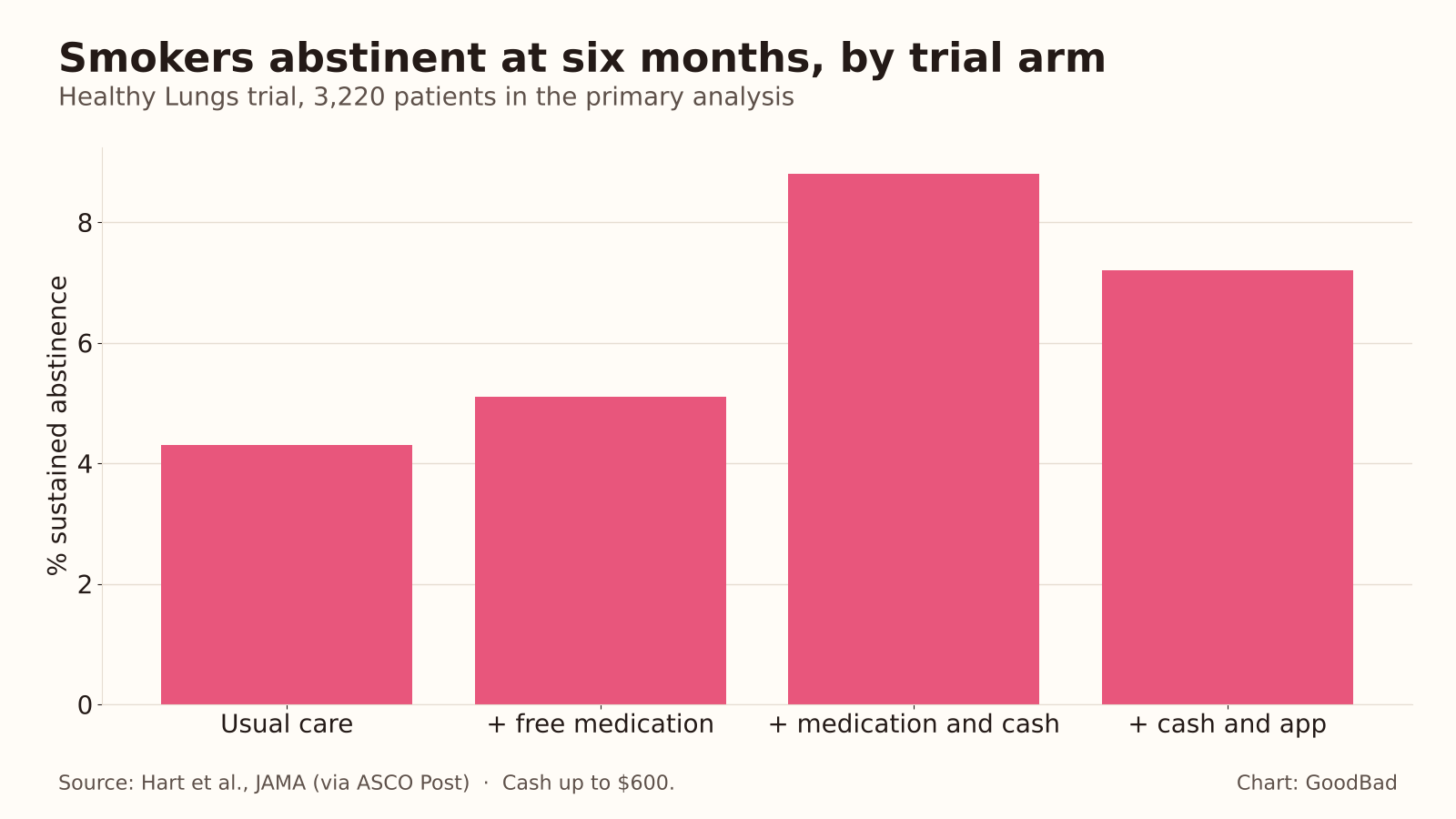 Chart: GoodBad. Data from Hart et al., JAMA, as reported by ASCO Post.
The cash arm beat both usual care and usual care with free medication (both P < .001), ASCO Post says. The mobile tool did not add anything on top of the cash (P = .19). The investigators say the approach could be scaled quickly, because it avoids labour-intensive one-to-one counselling.
A surprise about free medication
The result most clinics will want to read twice is the second bar. Free medication alone produced 5.1 percent abstinence, which the paper found was not significantly different from usual care (P = .66). The authors concluded that offering free medication, a common practice, did not promote quitting in this unselected group.
Who is in the trial
The median age was about 61, and 60.3 percent were women. Some 25.5 percent of participants were Black and 8.9 percent were Hispanic. Rural residents made up 38.8 percent, and 47.1 percent had household incomes at or below 200 percent of the federal poverty level. More than half (55.5 percent) smoked over ten cigarettes a day at enrolment.
What it would cost and what is next
The numbers are modest in absolute terms: roughly one in eleven people in the cash arm had quit at six months. That is still double the usual-care rate, and quitting lowers the risk of other cancers and heart disease. Henry Ford Health, one of the sites, says in a release carried by Medical Xpress that funding and routine rollout remain unresolved. That includes who would pay the incentives and how large long-term savings would be. The six-month endpoint also says nothing yet about whether people stay quit for years.