 Good news
Europe’s Hera Probe Sees Dimorphos Separately for the First Time Before Asteroid Survey
ESA’s Hera spacecraft has picked out Dimorphos, the asteroid NASA’s DART probe hit in 2022, as a separate point of light from its parent Didymos. Hera arrives this month, and the first detailed images are due on 25 November.
This story runs on the good side only. The biggest stories of the day are told on both sides.
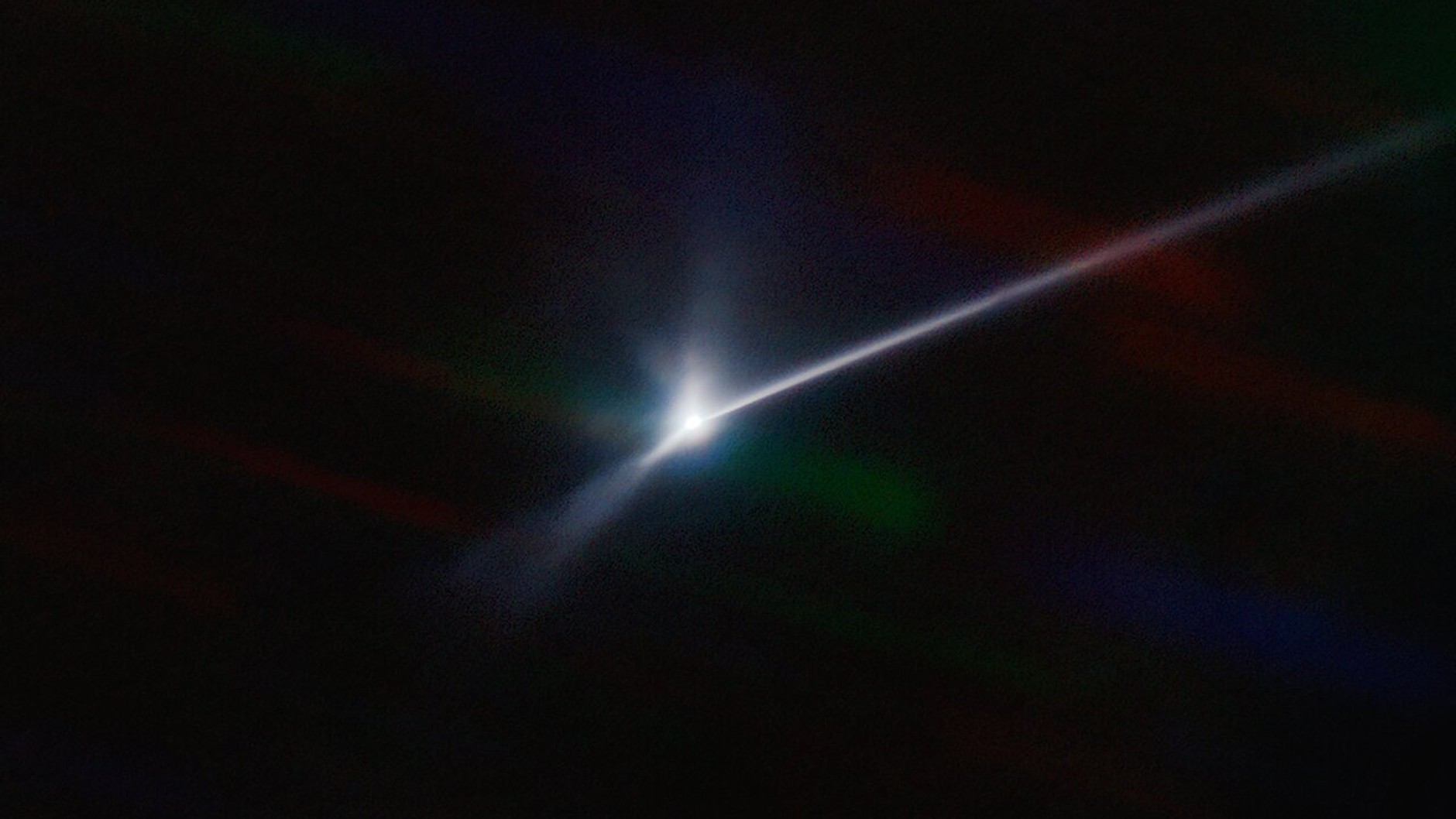
Four years after a NASA spacecraft crashed into a small asteroid on purpose, a European one has found it. The European Space Agency’s Hera probe photographed the pair on 18 October from 1,280 kilometres away, and Dimorphos, the smaller body, showed up as a separate point of light for the first time. The image, reported by Space.com, is one pixel of Dimorphos beside its parent, Didymos. It is a small picture with a large purpose.
Hera is Europe’s first planetary defence mission. Its job is to turn a one-off experiment into a technique that could be used if an asteroid ever threatened Earth.
Why one pixel matters
Until this image, the spacecraft saw the Didymos system as a single dot. Michael Kueppers, Hera’s project scientist at ESA, said Dimorphos is made up of only around one pixel but is clearly separated from its parent. Hera launched on a Falcon 9 rocket in October 2024 and made braking manoeuvres in October to slow its approach.
The pair are now about 197 million kilometres from Earth. ESA’s mission manager Ian Carnelli said the views will sharpen as Hera closes in, and that the first detailed images of Dimorphos will be unveiled on 25 November.
| Fact | Figure |
|---|---|
| Didymos, parent asteroid | About 780 m across |
| Dimorphos, the moonlet | About 151 m across |
| DART impact | 26 September 2022, a 550 kg spacecraft at 6.1 km/s |
| Change to Dimorphos’s orbit | Shortened by 33 minutes |
| Hera instruments | 12 payloads and two cubesats |
| First detailed images | 25 November 2026 (ESA) |
Sources: ESA; Space.com.
What DART left unfinished
The impact worked better than predicted. DART shortened Dimorphos’s orbit by 33 minutes, far beyond earlier estimates, ESA explains. The reason is thought to be debris thrown out by the impact, which pushed back like a rocket thrust. Scientists call this extra push the beta factor. The current estimate is that about 2.1 times the spacecraft’s own impact force was passed to the asteroid.
That is good news for the idea of deflection, but it comes with a gap. The mass of Dimorphos is still uncertain to within tens of percentage points, according to ESA. Until it is pinned down, nobody can say exactly how efficient the method is. Hera will measure the mass by tracking surface features and, near the end of its six-month mission, by the tiny Doppler shifts in its radio signal as it orbits close to Dimorphos.
The questions Hera will answer first
ESA lists ten mysteries. The first is whether DART left a crater. The impact is estimated to have dislodged about 16 million kilograms of dust and boulders, roughly 0.5% of the asteroid’s mass. In Dimorphos’s very low gravity, which is about two hundred thousandths of Earth’s, a crater’s size depends on how sticky the surface material is.
The second is safety. Modelling suggests most of the debris has left the system, and one recent study cited by ESA says more than 93.5% of the material would have escaped within two years. Only 0.002% would remain nearby. Hera still has to check.
The mission also carries two cubesats, the small satellites that will go in for a closer look. One of them, Juventas, carries the smallest radar ever flown in space and will make the first radar probe inside an asteroid. ESA says its resolution of about 10 metres is enough to show large voids, so scientists will learn whether Dimorphos is solid, porous or a loose bunch of boulders.
Does this affect me?
Not directly. Neither source describes the Didymos pair as a danger to Earth, and the value of the mission is long-term. If a dangerous asteroid is ever found, planners would want to know how much a kinetic impact moves it, and what happens to the rubble. Hera supplies those numbers.
What happens next
Hera continues its approach and prepares for arrival this month. The 25 November release is the next date. After that comes the six-month survey, including the first attempt to land a cubesat on Dimorphos. The open question is how the surface will hold up. ESA notes that a very weak surface could swallow a lander like sinking sand, which is one of the things the mission exists to find out.