Good news
Final Roll-Out Solar Array Installed on Space Station, Lifting Power Toward 215 Kilowatts
Two astronauts bolted the eighth and last new solar array to the International Space Station on 5 November, completing a five-year upgrade that NASA expects to lift power from about 160 to 215 kilowatts until the station retires in 2030.
This story runs on the good side only. The biggest stories of the day are told on both sides.
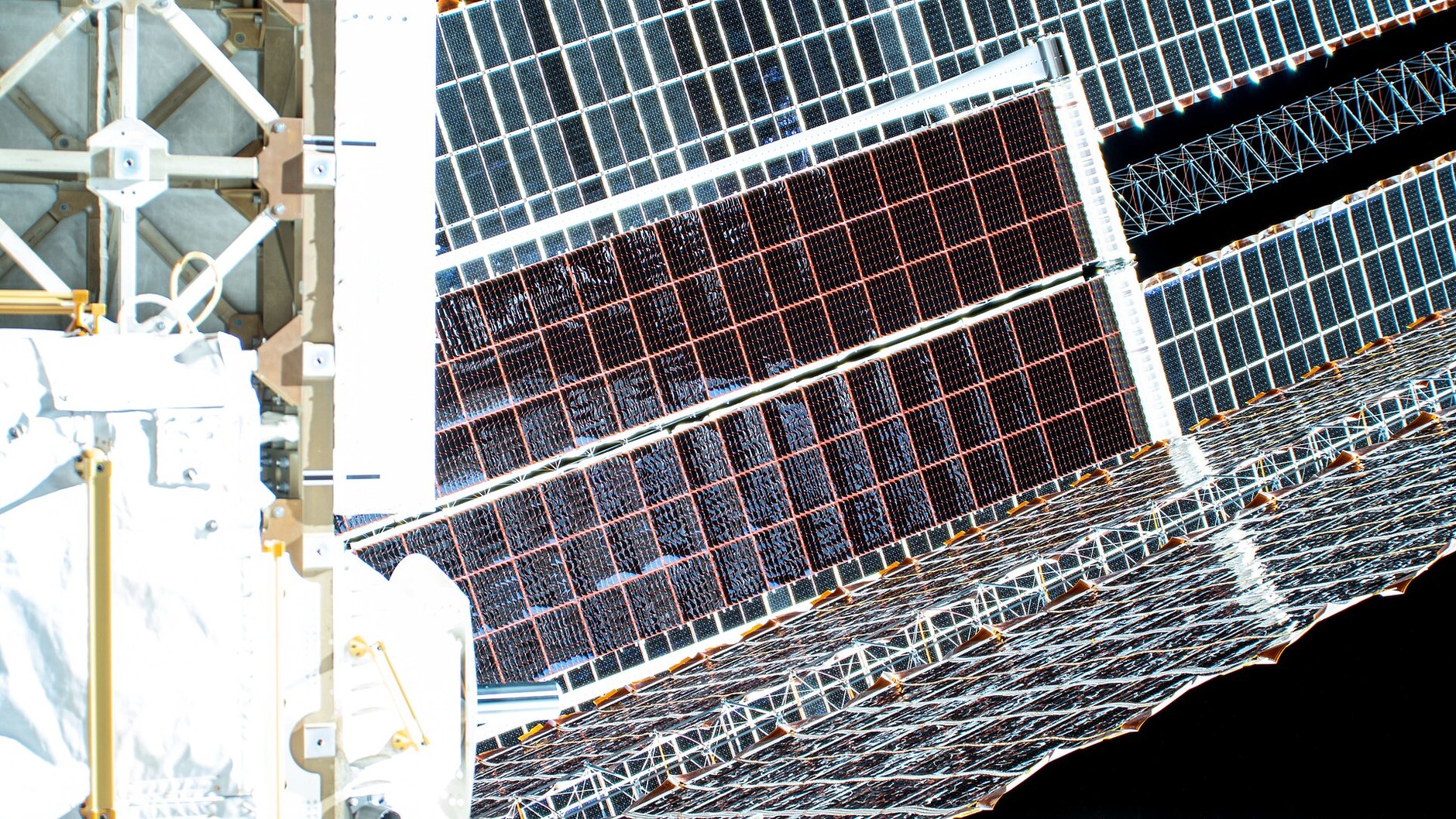
Two astronauts finished a five-year power upgrade on the International Space Station on Thursday. NASA’s spacewalk blog says Joshua Kutryk of the Canadian Space Agency and NASA’s Anil Menon went outside at 8:36 a.m. Eastern time to install the eighth and final ISS roll-out solar array, known as an IROSA. They came back in after six hours and 59 minutes, CBS News reports.
The station’s original arrays have been wearing out for more than two decades in the harsh space environment, and the roll-out arrays were designed to offset that loss. CBS says the original arrays were producing about 160 kilowatts before the first IROSA went up in 2021. With the eighth in place, the station is expected to reach around 215 kilowatts. That is enough to run life support, computers, research and visiting vehicles until its planned retirement and de-orbit in 2030.
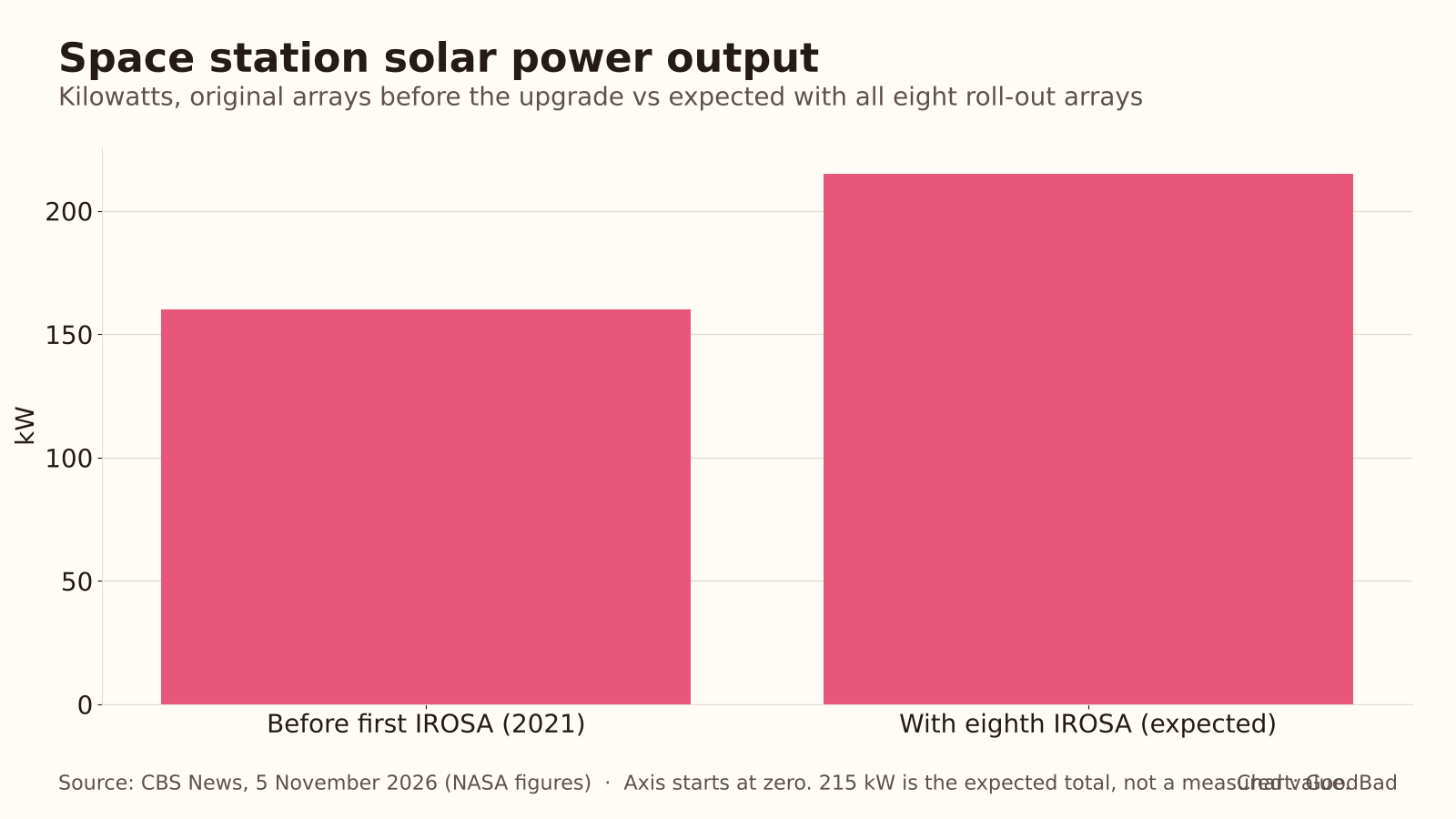 Chart: GoodBad. Data from CBS News reporting on NASA figures, 5 November 2026. The 215 kilowatt figure is an expectation, not a measurement.
Why smaller panels give more power
The new arrays are smaller than the ones they sit on, but they use newer, more efficient solar cells. They cover part of the old wings, which shades some of the old cells, and still deliver a net gain, CBS explains. Menon said afterwards that they are about half the size of the old arrays and deliver 40% more power. That is his claim on the day, not a measured result for the whole station.
Arithmetic puts the expected gain at roughly 55 kilowatts, or about a third on the 2021 level. Neither source gives what the programme cost, and neither says how much of the 55 kilowatts each array supplies. Those are the numbers a reader would want next, and the two sources do not publish them.
Eight wings, eight upgrades
The station has eight original solar wings, and each new array sits at the base of one of them. The programme started in 2021 when two spacewalkers installed the first IROSA, and six more followed on later spacewalks, CBS reports. The table sets out the milestones that the two sources confirm.
| When | Milestone |
|---|---|
| 2021 | First IROSA installed at the base of an original wing |
| 2021 to 2026 | Six more installed on later spacewalks |
| Earlier in November 2026 | Final two arrays delivered by SpaceX Cargo Dragon |
| Last week | Seventh installed by Menon and Kutryk |
| 5 November | Eighth installed on the station’s 3B power channel; spacewalk lasts 6 hours 59 minutes |
Source: NASA spacewalk blog and CBS News, 5 November 2026.
For readers on Earth the direct effect is small: the station’s power supply does not touch household bills or national grids. The effect is on what the lab can do. More electricity means more experiments running at once and more room for visiting vehicles to dock and draw power, both of which CBS lists among the loads the arrays support.
The hard part was the last one
The final two arrays arrived earlier this month in the unpressurised trunk of a SpaceX Cargo Dragon capsule, each folded in half. The station’s robot arm mounted both on the left side of the power truss to wait. The seventh went up last week, in a spacewalk by Menon and Kutryk, and was straightforward because the 58-foot Canadarm2 could carry Menon directly to the fixture.
The eighth was different. The robot arm does not have the reach to carry an astronaut and a blanket to the far right end of the truss. So Menon and Kutryk handed the array to each other, leapfrog fashion, until it reached a waiting support frame. They unfolded it, bolted it down and connected power and data cables in orbital darkness, when the panels could not generate electricity.
When the station moved back into sunlight, flight controllers saw that one of the two rolled-up blankets was not producing a small amount of electricity that was expected. The spacewalkers waited for another night pass to check the connections. The problem was fixed, and the blankets were unrolled to their full length of about 63 feet, according to CBS.
What it changes
For researchers on board, a bigger power budget is the point. Menon said the arrays are what makes the crew’s research possible. A station that is expected to operate until 2030 needs stable power for that whole period, and the old arrays had been losing output year by year.
The upgrade also shows how an ageing structure can be extended in small, repeatable steps. Eight roll-out arrays were attached over five years, one at a time, by crews working outside in suits and moving the new units by robot arm and by hand. NASA’s blog confirms that the last one is the eighth and that it completes the station’s power augmentation.
A fair question is how much of the gain is already banked. Seven arrays were in place before Thursday, so part of the extra power has been flowing for months or years, depending on when each went up. The 215 kilowatt figure is the total for all eight, and CBS gives no schedule showing how output rose with each installation. The one fault on the final array, a blanket that was not producing the expected trickle of power, was cleared before the array was fully extended.
What happens next is mostly a matter of waiting. The station’s retirement is scheduled for 2030, and neither source describes the plan for the de-orbit or what will replace the research platform. The measured output after commissioning is the number to watch, because 215 kilowatts is an expectation until NASA reports it.