Good news
Roundup Cancer Patients Get Guaranteed Payouts as Judge Approves Bayer’s $7.25 Billion Deal
A Missouri judge has approved a nationwide settlement under which Bayer pays up to $7.25 billion over as many as 21 years to people with non-Hodgkin lymphoma linked to Roundup, including those diagnosed in future. Bayer denies the weedkiller causes cancer.

Read the bad side of this story
Roundup Payouts Average as Little as $10,000 Under Bayer’s Approved $7.25 Billion Deal

People who developed non-Hodgkin lymphoma after using Roundup now have a payment schedule they can count on. On Friday 20 November a Missouri judge gave final approval to a nationwide settlement. Bayer pays up to $7.25 billion into a fund over as many as 21 years, according to the Associated Press. It covers people who are ill now and people who are diagnosed in future.
Bayer, the German owner of Roundup, denies that the weedkiller causes cancer. The company has agreed to pay anyway, and a court has found the terms fair.
What claimants receive
Individual payments are set by a formula. The AP reports that participants could receive an average of between $10,000 and $165,000, depending on how they used the product, their age at diagnosis and how severe the illness is. NPR adds that exposure through agricultural or other work counts for more than occasional use.
At the top end, agricultural, industrial or turf workers with long exposure who were diagnosed with an aggressive form of the cancer before 60 could receive an average of $165,000, the AP says. Someone diagnosed at 78 or older would receive an average of $10,000.
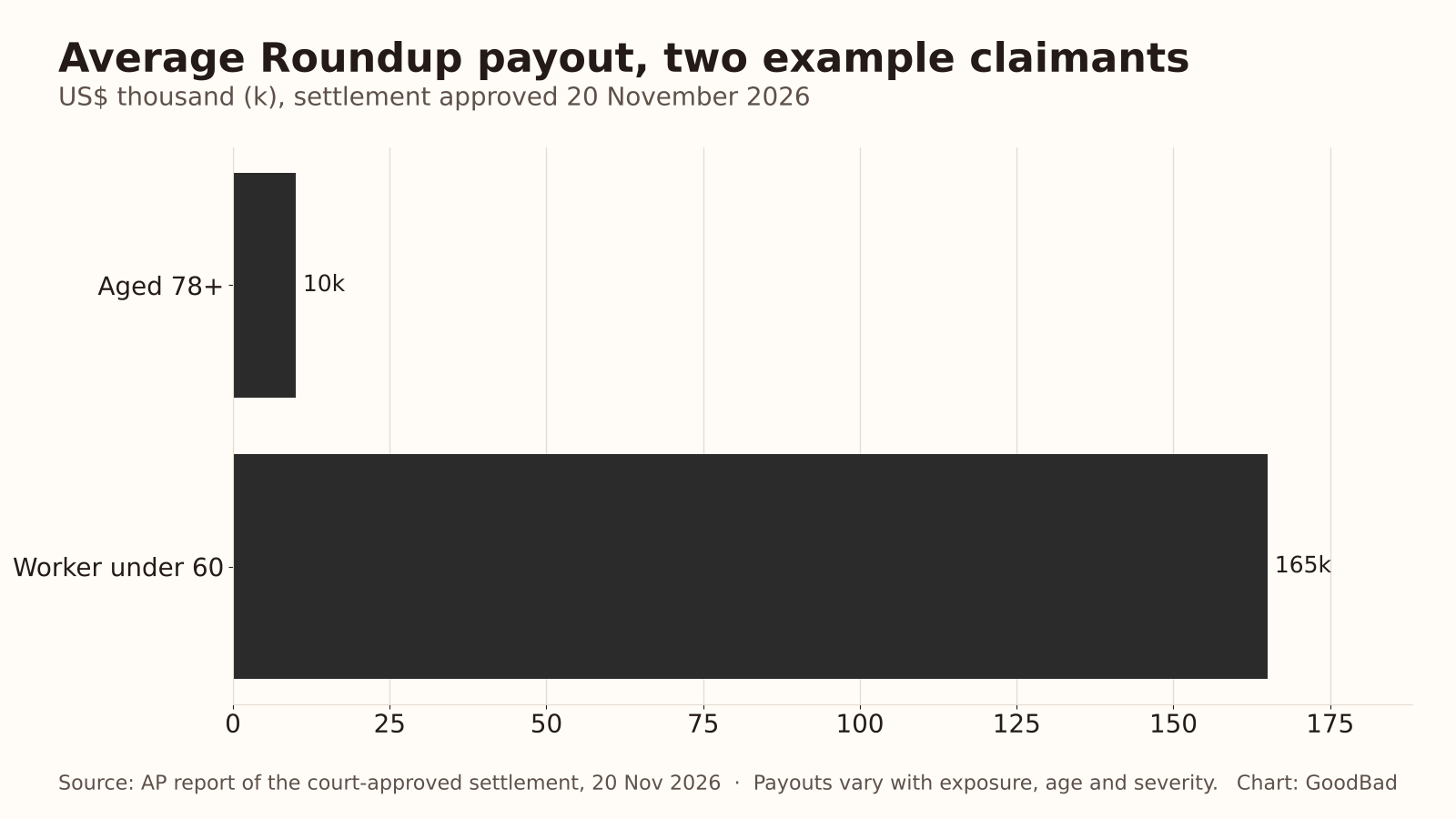 Chart: GoodBad. Data from the Associated Press report of the settlement, 20 November 2026.
The money is paid in annual instalments into a special fund. That structure gives claimants a guaranteed route that does not depend on winning a jury verdict, which has been a lottery. About 200,000 Roundup claims have been made against Bayer, according to the AP, and only a couple of dozen cases have reached a jury, with verdicts going both ways. In one, a Georgia jury awarded plaintiffs $2.1 billion; in October, a Missouri jury sided with Bayer.
Why a deal now
The settlement was proposed in February, and the legal ground shifted while it waited. In June the US Supreme Court ruled 7 to 2 in Bayer’s favour, the BBC reports. It found that the company cannot be sued in state courts for failing to warn about cancer, because federal rules do not require a cancer warning label.
That ruling weakened the main argument in thousands of lawsuits. Some attorneys for cancer patients say the payouts are too small, the AP reports. Others argue the deal beats the alternative, which after the Supreme Court decision was a real chance of getting nothing.
The judge, Timothy Boyer of St Louis Circuit Court, ruled the average payouts fair and adequate and called the total among the largest in the history of mass tort personal-injury class action settlements. The BBC reports that he declined to delay payments to sick people while objections were argued.
Who is covered
The settlement is nationwide and is open to people exposed to Roundup before it was proposed in February, the AP reports. That includes people who have not yet been diagnosed but may be in future years. Roundup was introduced by Monsanto in 1974 and became one of the most widely used herbicides in agriculture, and Bayer acquired it with Monsanto in 2018, according to the AP.
NPR calls Roundup the most widely used weedkiller in the world, which explains why the group of people with possible claims is so large. The fund’s annual structure is meant to keep paying as those diagnoses arrive, rather than ending when a lump sum runs out.
What it settles for Bayer
This is the second large payout. NPR reports that Bayer earlier agreed to pay between about $10 billion and $11 billion to settle more than 100,000 claims. The AP says Bayer had previously set aside $16 billion for Roundup legal costs, and that this settlement comes on top of that money.
For the company, the AP says, the deal provides financial certainty against litigation costs that had led it to consider pulling the product from US agricultural markets. Bayer’s chief executive, Bill Anderson, described the settlement as a milestone in the company’s strategy to reduce the risk from pending and future cases, according to NPR.
Bayer has also changed what it sells to households. Roundup products for residential use in the US no longer contain glyphosate, according to the AP and NPR, though the chemical remains in agricultural use.
What the science says
Whether glyphosate causes cancer is still disputed. The International Agency for Research on Cancer, part of the World Health Organization, classified it in 2015 as probably carcinogenic to humans. The US Environmental Protection Agency has found it is not likely to cause cancer in humans when used as directed, and says it is reviewing the evidence again, NPR reports. The settlement does not settle that scientific question, and Bayer has not accepted the claim. NPR adds that the Trump administration sided with Bayer in the Supreme Court case.
What happens next
The decision could be appealed, the AP notes. If it stands, the fund starts paying out over its annual schedule, and people exposed before the settlement was proposed in February can claim in future years if they are diagnosed. Christopher Seeger, the court-appointed counsel for cancer patients, said the order delivers guaranteed compensation to people who have waited more than a decade, according to the BBC.
For anyone with a diagnosis, the practical step is to check the settlement’s claim rules and deadlines, which these reports do not set out in full. For the many who sued and waited, a result that pays is the news.