 Good news
63 Countries Have Now Eliminated a Tropical Disease, Up From 42 in 2020
WHO's mid-term report says 63 countries have eliminated at least one neglected tropical disease and 1.41 billion people need interventions, 36% fewer than in 2010. Most 2030 targets remain behind, and funding is 30% below pre-COVID levels.

Read the bad side of this story
Only Three Tropical-Disease Targets Hit 2025 Milestones as Dengue Cases and Deaths Rise
Sixty-three countries had eliminated at least one neglected tropical disease by June 2026, up from 42 at the end of 2020. The World Health Organization reported the figure on 4 November in the mid-term assessment of its 2021–2030 road map. The number of people needing treatment or prevention for these diseases fell to 1.41 billion in 2024, which is 36% fewer than in 2010 and 19% fewer than in 2020.
Most 2030 targets are still behind schedule, and the report says so plainly. This piece starts with what has moved, because it is substantial, and then sets out what the report says is holding the rest back.
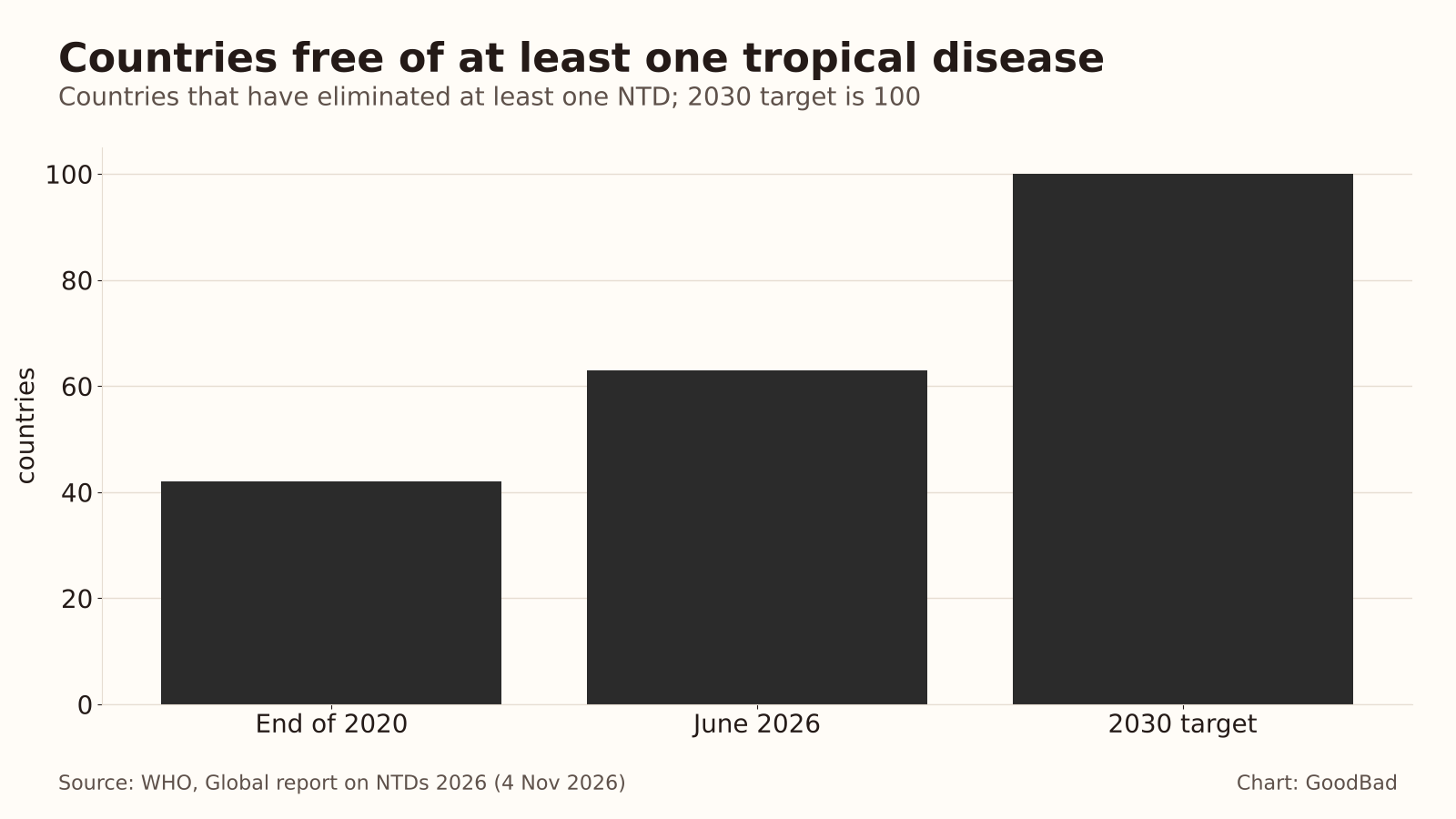 Chart: GoodBad. Data from WHO, Global report on neglected tropical diseases 2026, 4 November 2026.
Diseases in retreat
The road map covers 21 diseases and disease groups, from river blindness and sleeping sickness to dengue and snakebite. Cases of sleeping sickness have dropped by 98% since 1999. Guinea worm disease reached a record low of 10 human cases in 2025. Togo became the first country to eliminate four of these diseases, according to Health Policy Watch.
WHO’s Director-General, Tedros Adhanom Ghebreyesus, called the elimination effort “one of the standout success stories of global health”. The count is 21 higher than at the end of 2020. The road map’s goal is 100 by 2030, which leaves 37 more countries to go.
New tools reaching patients
The report credits science with a run of new products. WHO has prequalified a child-friendly formulation of praziquantel, called arpraziquantel, for schistosomiasis, and generic miltefosine for leishmaniasis. A dengue vaccine and two chikungunya vaccines are available, and new medicines for onchocerciasis and human African trypanosomiasis have received regulatory approval.
A summary of the report notes that 43 countries have adopted an integrated strategy for skin-related neglected tropical diseases, already above the 2030 target. Integration means one health worker visit, one set of supplies and one training programme covering several diseases.
| Measure | Latest figure | Source note |
|---|---|---|
| Countries that eliminated at least one disease | 63 (June 2026), from 42 (end of 2020) | 2030 target: 100 |
| People requiring interventions | 1.41 billion (2024) | 36% below 2010, 19% below 2020 |
| Sleeping sickness cases | down 98% since 1999 | WHO |
| Guinea worm human cases | 10 in 2025 | record low |
| Countries with skin-disease strategy | 43 | already above the 2030 target |
Table: GoodBad. Figures from WHO’s 2026 report and summary.
The gaps it names
The report is a mid-term evaluation, and WHO is candid about its limits. Only three disease-specific indicators reached their 2025 milestones. Dengue cases hit a record 15.1 million in 2024, and deaths from vector-borne neglected tropical diseases have risen. Yaws eradication is off track, and the summary says neither eradication programme is on track.
Money is the main constraint. Resources for these diseases remain 30% below pre-COVID levels. A small number of donors supplied nearly 80% of aid between 2018 and 2024, which left programmes exposed to abrupt cuts that disrupted mass treatment and put donated medicines at risk of expiring.
What it means for you
For a person living in an affected district, the practical gains are drugs in child-friendly form and one visit that covers several diseases. For taxpayers in donor countries, the report asks donors to broaden support across the full range of interventions instead of a few. For governments in affected countries, it calls for more domestic financing and for adding these services to universal health coverage.
The next checkpoints are the full 2024 data tables in the 298-page report and WHO’s priorities for 2026–2030. Whether 100 countries is reachable depends mainly on funding that has not yet been pledged.